



KALTEC

Application Intelligence for Specialty Chemicals

Connect the site to your products with technical reasoning, and deliver a document made for each customer Contact us
  • 96,690

    Process analyses to date

  • 800k+

    In-house technical documents

  • 1.7M

    Average output tokens per problem

  • 100+

    Factors analyzed per report, on average

A technical team working with an AI engineer

Sites change fast and processes keep getting more complex. For accurate application, site records, product data and technical documents are gathered in one place, reread through technical reasoning, and turned into documents fitted to each customer and case. Your staff focus on site experience and judgment, and customers get documents with clear evidence.

Application IntelligenceWork Logs
Application IntelligenceAccounts · Customer A
Application IntelligenceProjects
Application IntelligenceAgent
Application IntelligenceTasks
Application IntelligenceField Care
Application IntelligenceAccounts · Customer A
Application IntelligenceAgent

Site data becomes the customer's asset

Visit notes and readings become each customer's application data, the basis for reliable use. Agents do the technical work; engineers focus on judgment.

Agents

Technical reasoning connects
field experience to theory.

The agent runs the right task for each case and handles many cases at once. It reads site data from several angles on the basis of science and mechanisms, and separates confirmed facts from inferences to support the engineer's decision.

  • Many cases at once
  • Read through the mechanism
  • Tuned to your team

Dataroom

Accurate answers come from
your internal documents.

Internal documents such as TDS, SDS, CoA, certificates and case studies are tagged as they are uploaded. The agent finds answers across all of it, compares the source files behind each point and cites them, and our engineer opens any source in one click.

  • Tagged on upload
  • Every point cited
  • Your documents only

Field Care

A dedicated agent responds to
each customer in real time, any time.

Each customer has a dedicated agent that takes questions at any time. It doesn't just log them: it gives technical answers from the material shared with that customer. Instead of waiting on email, customers ask, follow up and keep the conversation going.

  • Real-time conversation
  • Technical answers from what you share
  • Decisions go to your team

Work Logs

Scattered visit notes,
organized as structured data.

When our engineer writes up a visit the way they would say it, the agent splits it into readings, observations and next steps and files the log. Readings stack by date in the project, and the log becomes site history the agent reads first on every case.

  • Sorted by field
  • Readings flow to the project
  • Read before every case

Projects

Every customer site's
history, in one place.

Every customer site is a project holding its operating conditions, products in use and readings. Readings stack by date and are never overwritten, and the agent adds new ones from the logs straight away. When a problem appears, what changed before it is easy to see.

  • Readings over time
  • Products in use
  • Always up to date

Accounts

Everything exchanged with
each customer, kept on its own.

Each customer account holds its own contacts, work logs, projects, reports and dataroom files. In Field Care, a customer sees only what was shared with their own account, so one customer's information never mixes with another's.

  • Kept per customer
  • Every document on record
  • Customers see only their own

Integrations

No customer email or
meeting request slips through.

With email and calendar connected, the agent reads customer mail alongside that customer's records and turns meeting requests into calendar entries. Replies are drafted with the report already attached.

  • Read with the account's records
  • Meetings onto the calendar
  • Drafts with the report attached
Measured results

What changed for our technical team

visit_Customer A_1104.txt

Customer A central sump, foam + smell again

worst on monday morning after the weekend

conc 7%? refractometer photo on my phone

pH 8.9 (was 9.2 last time??)

skimmer broken they said, check

Kim asked for biocide sample by fri

send quote again

TDS for the new coolant, which rev?

call Lee about the test kit

Visit notes scattered across text files and chat
Application Intelligence
Written as you said it, linked to the site's record
Customer A_sump_log_v3_final(2).xlsx
E5fx=VLOOKUP(A5,Sheet1!A:F,5,0)
ABCDEF1DateConc %pHTemp °CBacteriaNote22025-07-027.29.12610^432025-08-117.0?staff on leave42025-09-016.88.929heard on a call5#N/A62025-10-208.710^6?see email72025-11-04731foam again91011
Sheet1Sheet1 (2)old
Site conditions kept in memory and a few spreadsheet cells
Application Intelligence
Every reading kept over time on the site's record
Marco LindqvistNorvale Machining

Line 3 sumps are foaming over every shift since we refilled with RO water.09:12

Can you send something that works? We need it before the plant audit.09:13

Missed voice call · 10:42

Sorry, I was on site. I'll come by this afternoon.11:05

Also send the price and the data sheet for whatever you bring.11:20

Will do.11:21

Any update? Purchasing is asking.16:40

Message
Customer requests and calls left in a messenger thread
Application Intelligence
Contacts, reports, dataroom, projects and work logs in one account
Inbox
Sangmin Kim, Customer AMon 08:31

Concentration for the aluminium line?

Since the aluminium line came in, what concentration should we hold? We're worried about staining.

MeWed 17:52

Re: Concentration for the aluminium line?

Please find our product catalog attached. The recommended ranges are on page 14.

Product_Catalog_2025.pdf12.4 MB

Sangmin Kim, Customer AThu 09:05

Re: Re: Concentration for the aluminium line?

The catalog doesn't cover our mix of metals. Can someone call me?

Questions by email, answered days later with the catalog attached
Application Intelligence
A private space where the customer's agent answers from what you shared
AI assistant

Our central cutting-fluid sump foams and smells. What could be causing it?

Foam and odour in a cutting-fluid sump usually come from several factors acting together. The most common causes are:

1. Microbial contamination. Bacteria and fungi break down the fluid's components, producing hydrogen sulphide and organic acids that smell, and by-products that stabilise foam. Anaerobic bacteria grow especially when the system stands still.

2. Concentration out of range. Too high a concentration raises the surfactant level and the tendency to foam, and too low lowers corrosion protection and biostability.

3. Water quality. Soft water foams more easily, and hard water can destabilise the emulsion.

4. Tramp oil. Hydraulic and slideway oil form a film on the surface that cuts off oxygen and feeds bacteria.

5. Mechanical causes. High pump pressure, return lines that fall onto the surface, and leaks on the suction side entrain air.

Recommended actions: measure concentration and pH regularly, add a biocide, skim off tramp oil, consider a defoamer, and replace the fluid if needed. Because the exact cause depends on site conditions, consult your fluid supplier or a specialist.

Message
A long general answer, the same for everyone, with no source
Application Intelligence
Reasoned from your own records, every point cited
Problem_report_Customer A_draft.docx

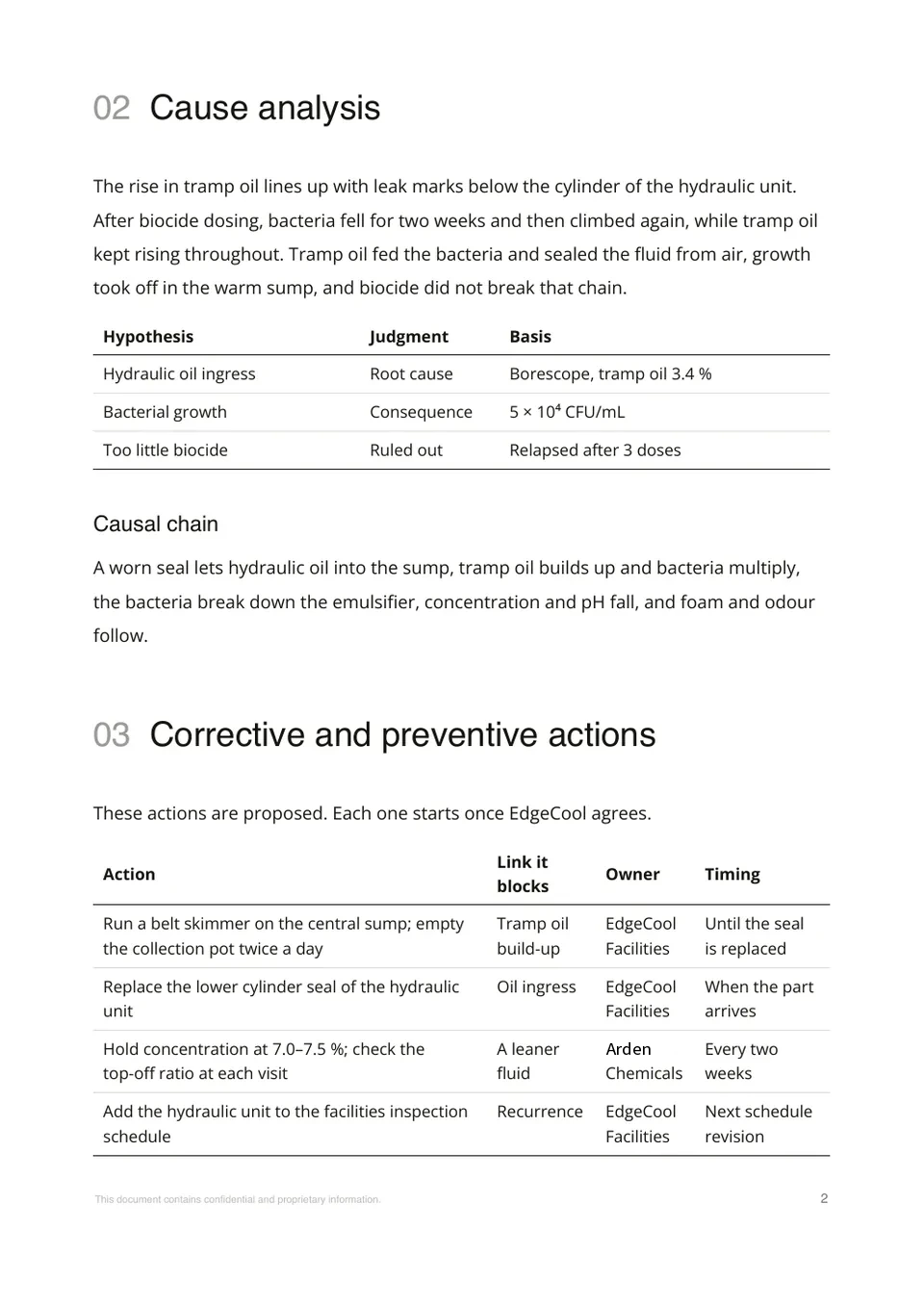
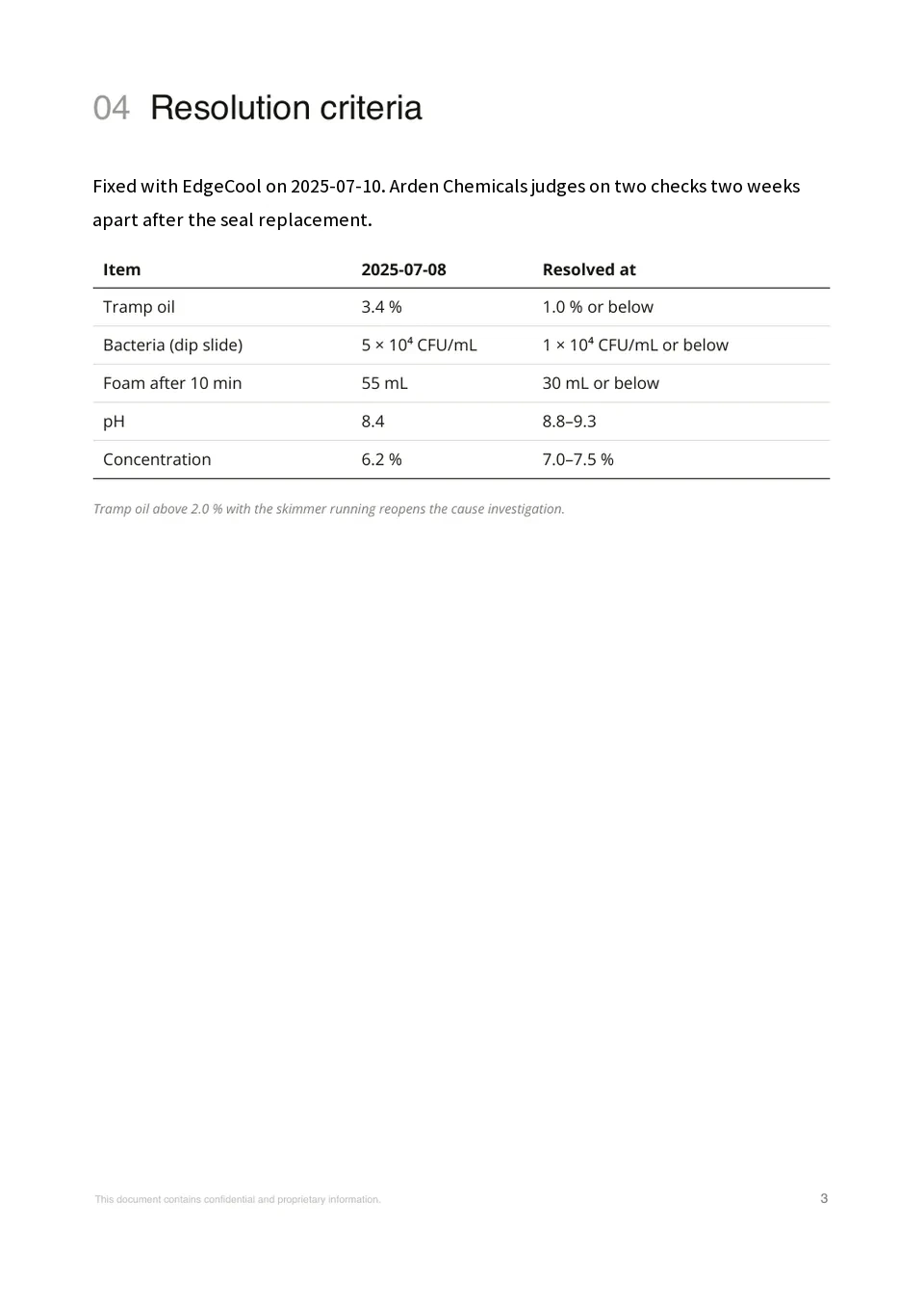
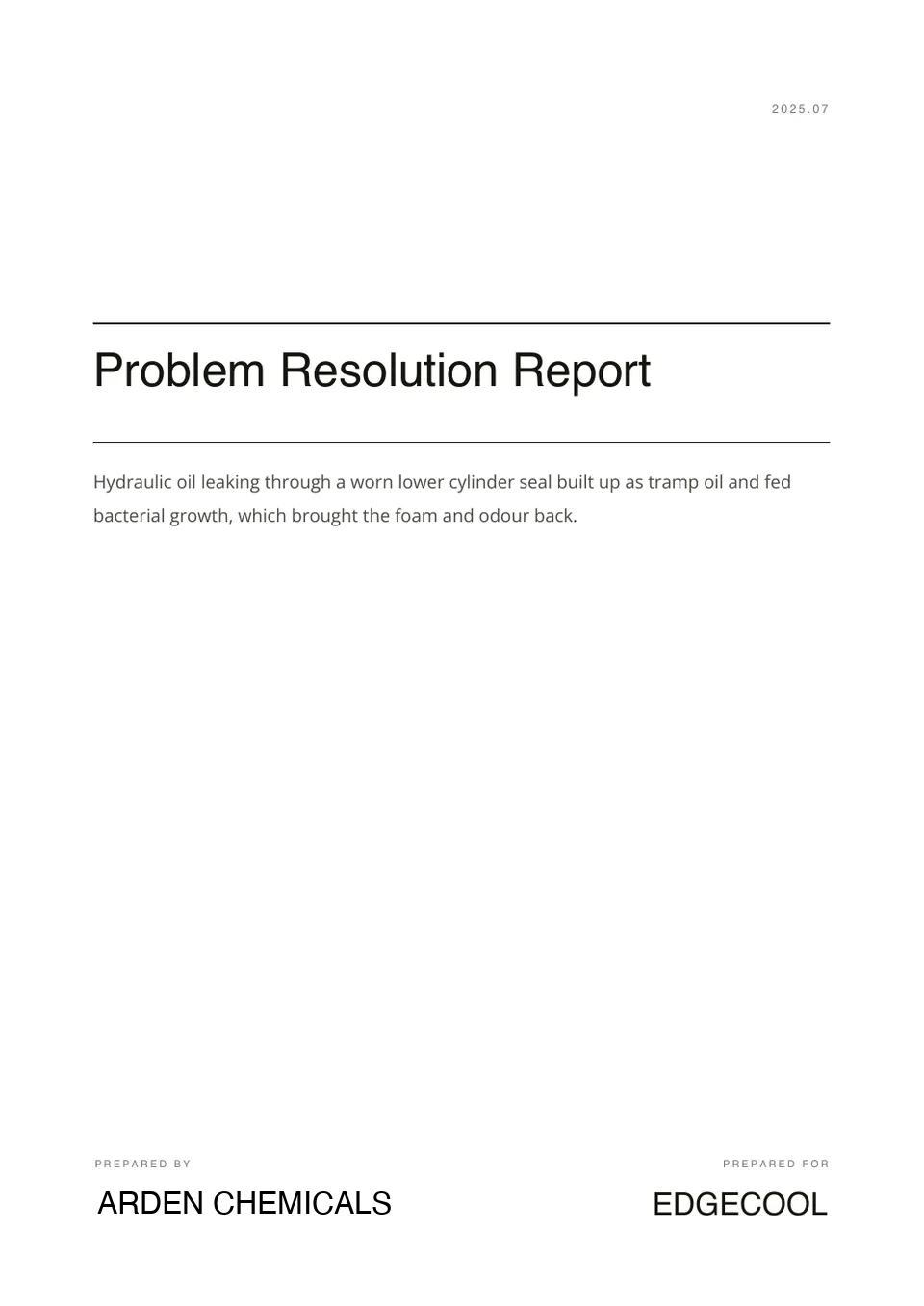
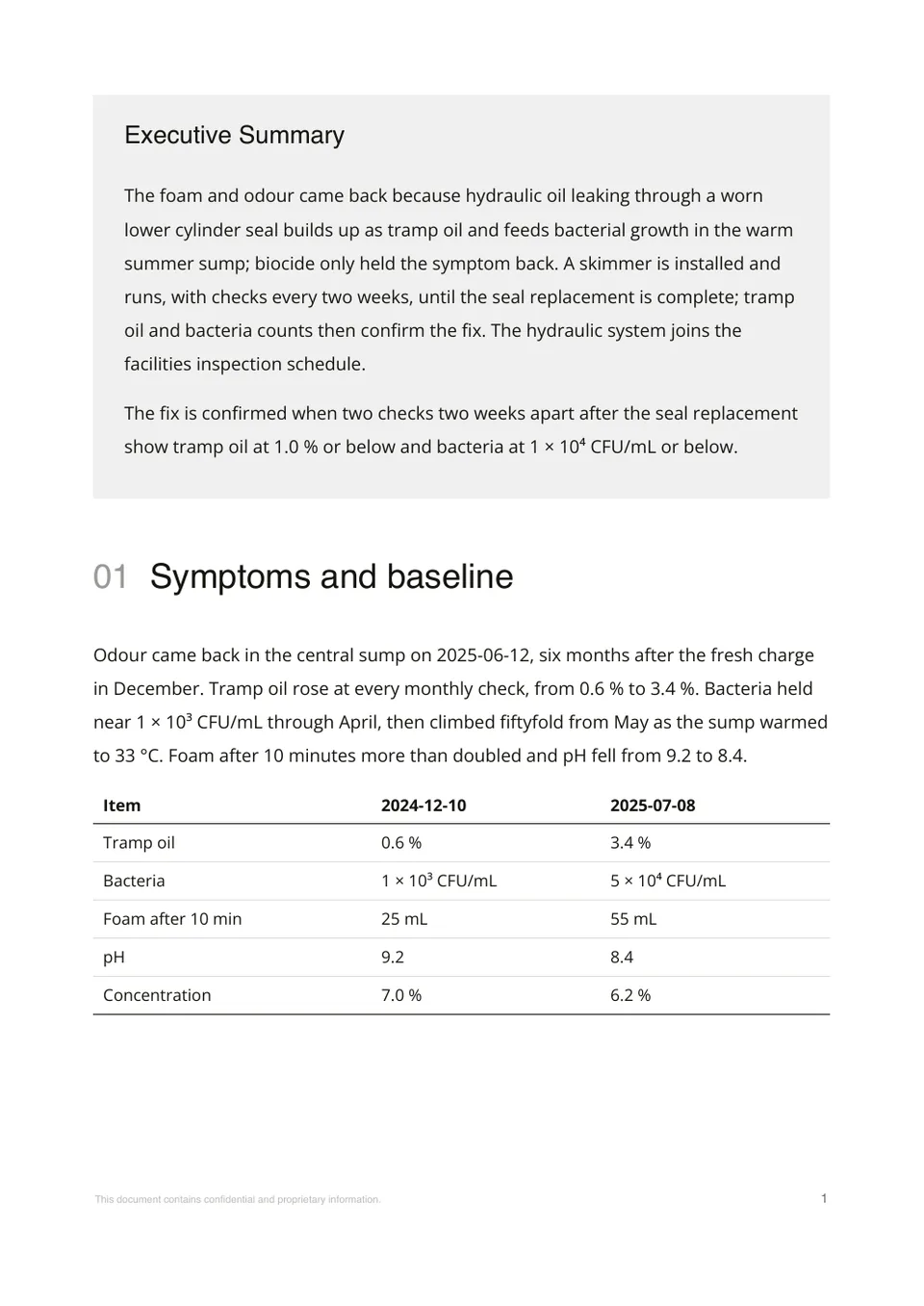
Problem report: central sump foam and odour

1. Symptoms

Foam and odour in the central sump since mid-October, worst after weekends.

2. Likely cause (in progress)

Bacteria? Concentration? [paste data from the sump log here]

3. Action

[after checking the TDS for the 3 candidate biocides]

ManagerPlease attach the readings and the source for each point.
Finding, comparing and writing, all done by hand
Application Intelligence
Delegated as a task. Your team judges and gives feedback

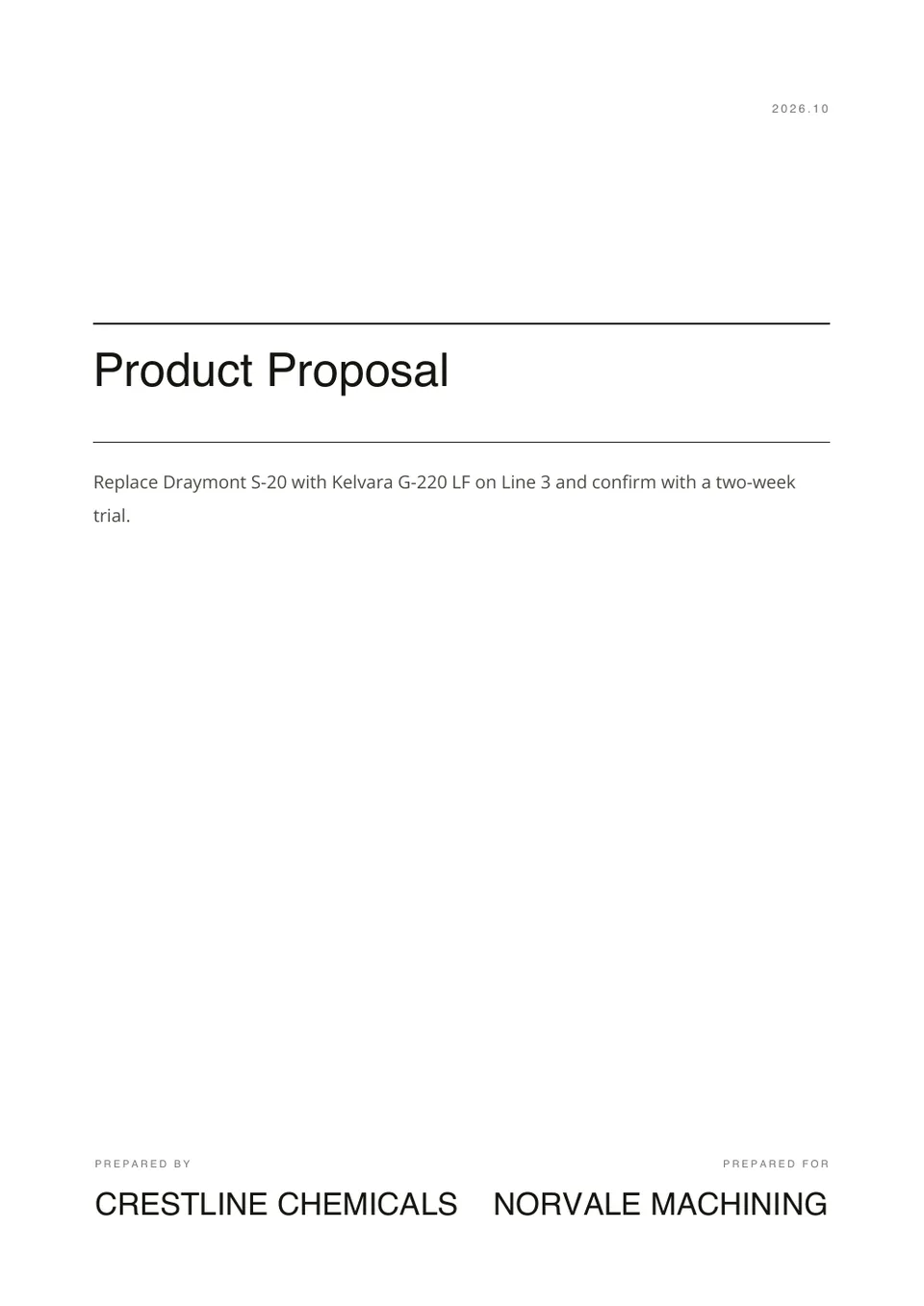
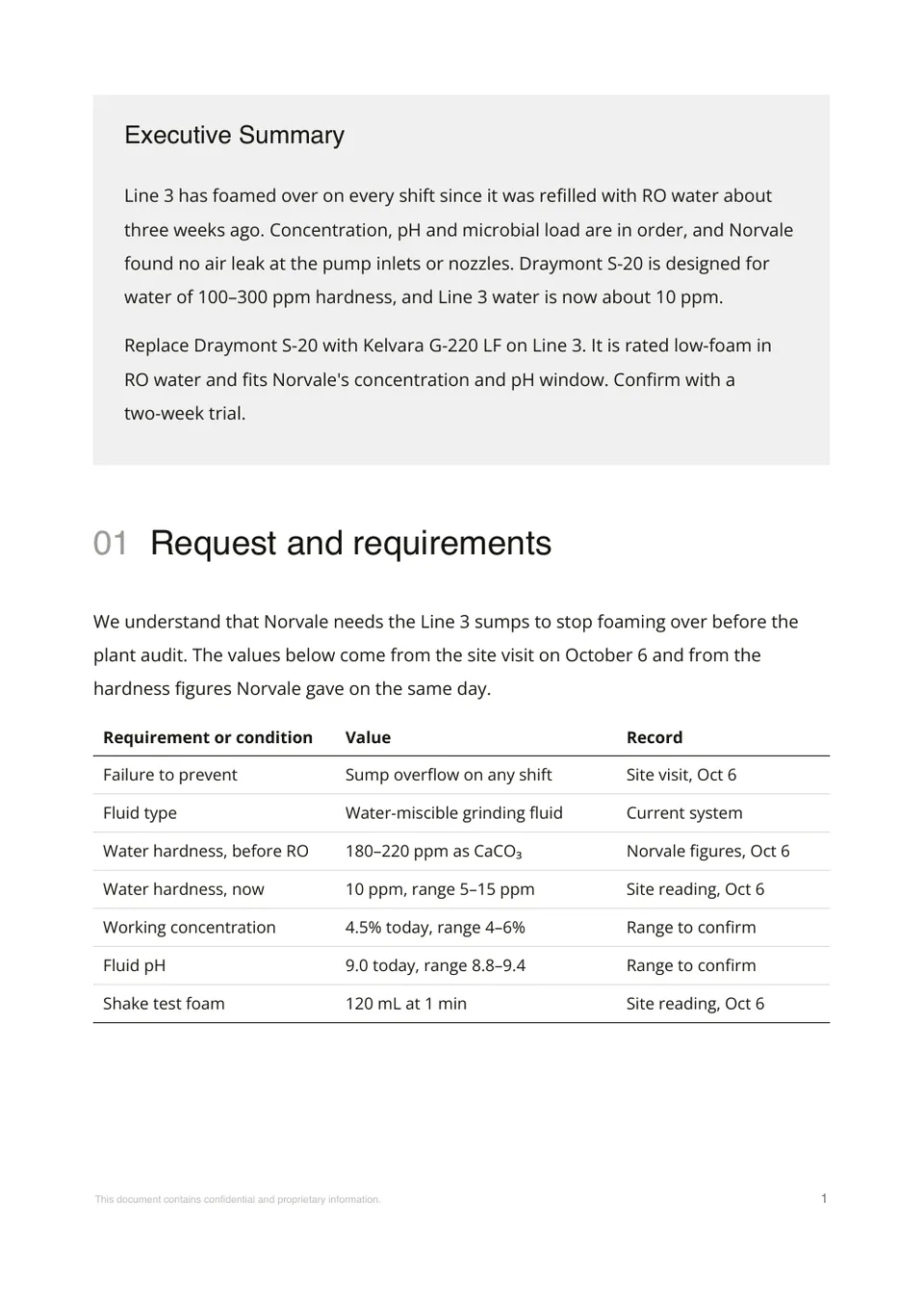
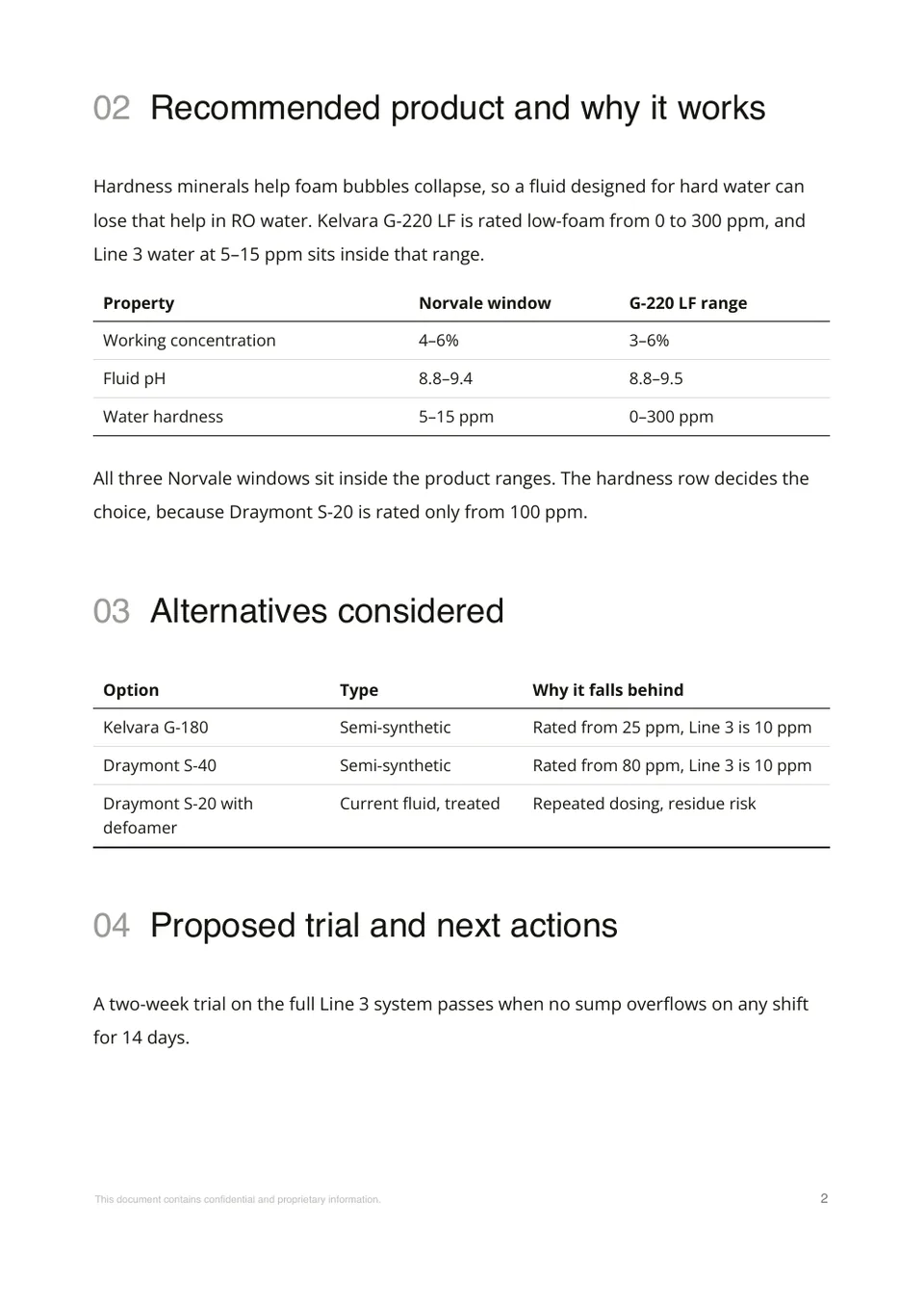
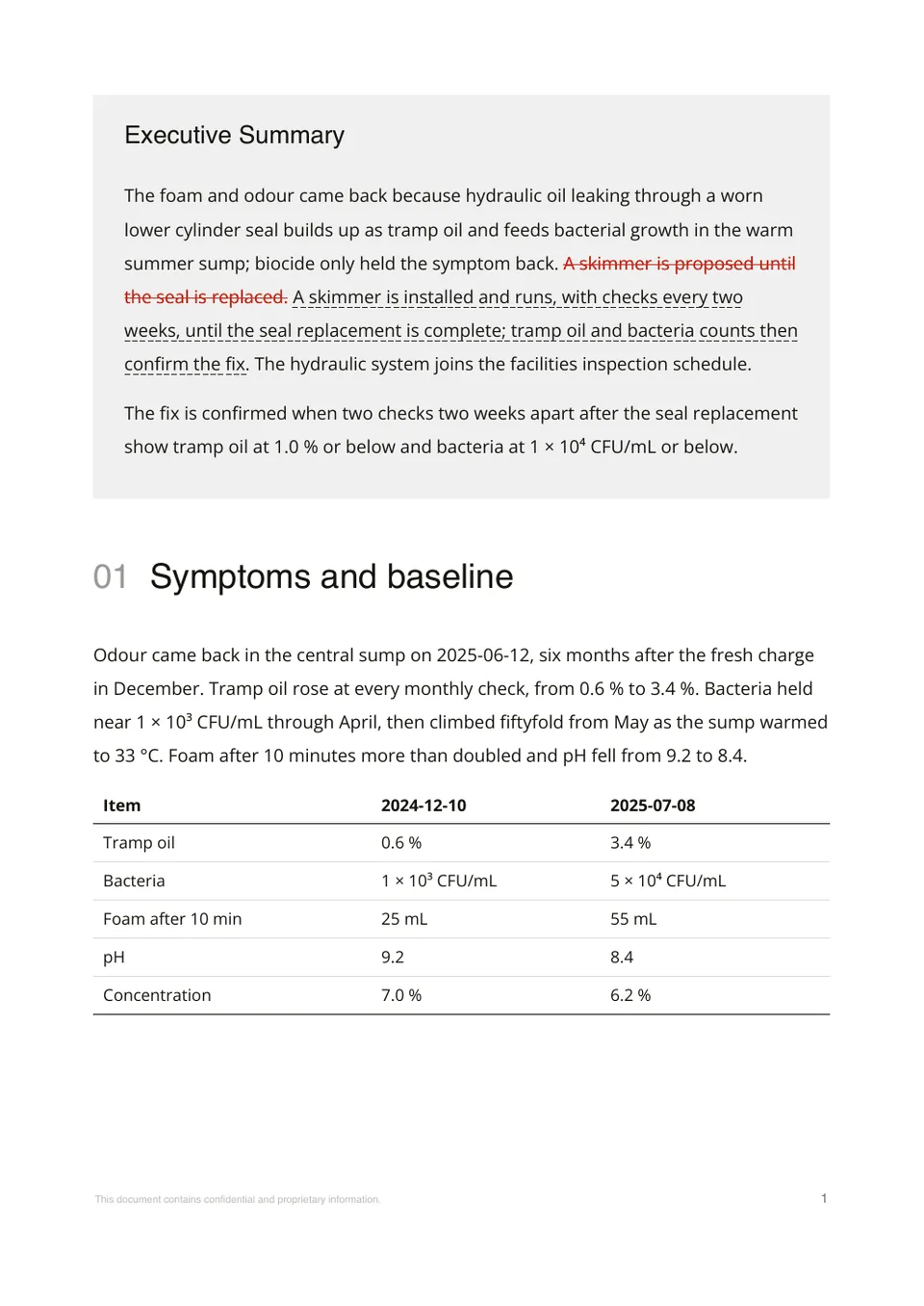
Application Intelligence is an agentic application platform built for specialty-chemicals technical support. Agents handle routine work on their own and work through complex cases with extensive search and repeated verification. Our engineers judge quickly and accurately, and customers get documents they can apply on their own site.

  • Grounded in verified data

    Answers start from your internal technical documents. Where those fall short, web research adds public sources such as manufacturer data and standards, and every point cites its source.

  • Mechanism-based reasoning

    We look past the symptom to the chemistry and mechanism behind it. Facts and inferences are kept apart, so every conclusion can be explained.

  • One document per case

    Each case gets its own document, with the evidence and a conclusion the customer can act on, so it turns into real results.

FAQ

What does Application Intelligence do?

Application Intelligence is the AI platform our technical team uses. It connects site operating conditions and readings to product data through technical reasoning, and writes a document for each customer on the cases that decide application: product recommendations, site problems, trials and quotes. It covers material protection, lubricants and metalworking fluids, adhesives and sealants, process chemicals and cleaning.

How is it different from a general AI assistant?

A general assistant answers from what it learned on the internet and gives everyone much the same answer. Application Intelligence works from our own data sheets, test reports and each customer's site history, and cites a source for every point. The output is not a chat reply but a document written for one customer's case.

How does the agent work through a case?

It sets out the customer's conditions and requirements, picks out the key factors, compares candidates against our own data and reaches a conclusion. Facts, inferences and open points are kept apart, so our engineer sees at once what the answer rests on and what still needs checking.

What if the agent gets something wrong?

An engineer checks the work. Where judgment is needed the agent asks first, and no document is final until the engineer approves it. Emails go out only after approval too, so nothing reaches a customer without the engineer knowing.

How are the brands' technical documents handled?

TDSs, SDSs and test data from the brands we carry are kept in our dataroom and serve as evidence when we choose products and make judgments. Documents for a customer leave out internal sources and other customers' records.

How we protect your data
What do our customers see?

Only what our engineer shares. In Field Care we pick, item by item, the documents, logs and site records each customer sees; nothing else is shared. Customers see only their own company's material, never internal notes or other customers' records, and their dedicated agent answers only from what was shared.

What does a customer need to prepare?

Nothing special. If you already have data sheets, test reports or site records, share them with us. We organize them into your site history, and your own systems stay as they are.