Robotics & Automation
From a single joint to an entire distribution center
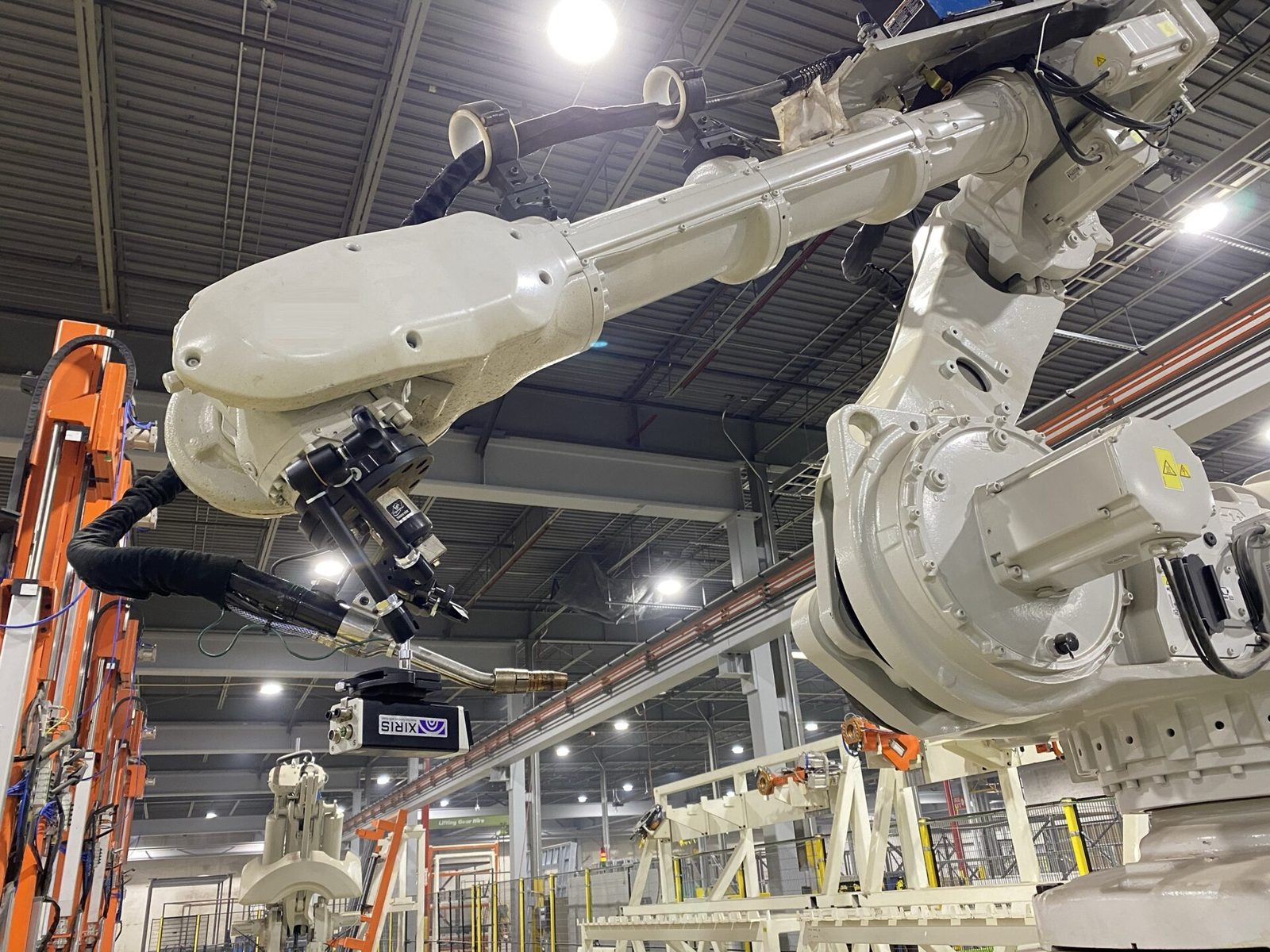
Robotics and logistics automation remove repetitive and hazardous work from factories and run unmanned high-speed sorting and transfer in distribution centers.
- $2.3M
One hour of downtime at a large car plant
- $18.1B
US factory downtime from poor maintenance
- 1/3
Bearing failures caused by lubrication problems
What is the robotics and logistics automation industry?
Robotics and logistics automation builds and installs equipment that takes over repetitive work and conveying that people used to do. A robot arm's performance depends heavily on how long the reducer inside each joint holds up at what temperature and load, and conveying equipment in distribution centers repeats the same motion all day. Because reducers, bearings, chains and electrical contacts of many different types are handled together, precision lubrication, contact protection and cleaning are set separately for each drive.
In robots, problems often show up as fine friction and contamination. When grease viscosity is wrong, starting torque and positioning accuracy waver, and on clean lines, particles shed from lubricants become defects directly. So beyond friction performance, behavior across temperature ranges, particle emission, and the salt or cleanliness conditions where the equipment actually stands must be checked. In this industry, reducer makers, robot builders and end users each hold different specifications, so there are several parties whose approval is needed.
- 01
Harmonic drive joints
In the main joints of collaborative and lightweight robot arms, a wave generator deforms a thin flexspline for reduction. Shock loads cause ratcheting that increases torque ripple. Choose grease by viscosity, friction properties and no-load starting torque.
- 02
Cycloidal reducer joints
In the joints of heavy-duty industrial robot arms for welding and handling, an eccentric input drives the gears to transmit torque to the output shaft. Higher input speed heats and thins the oil film, speeding eccentric bearing wear. Choose a lubricant by extreme-pressure performance, film retention and seal material compatibility.
- 03
Planetary gear drives for AGV and AMR drive wheels
Multi-stage planetary gears provide reduction in AGV drive wheels and conveyor drive shafts in distribution centers. Heat built up by repeated motion wears bearings early. Choose grease and gear oil by low friction, heat dissipation and continuous run time.
- 04
Worm gear reducer drives for conveyors and sorters
In low-speed, high-torque drives of conveyors and sorters, worm and worm wheel mesh with sliding to provide reduction. Low flow or the wrong viscosity raises heat. Choose gear oil by viscosity grade, oil temperature and miscibility with the existing mineral oil.
- 05
Irregular task applications
Robots are deployed in processes where load changes every cycle, such as packing and pick and place. Specifying by average load leads to repeated overload damage in peak load ranges. Choose fluid by peak-load basis and oil film recovery after shock.
- 06
Shipbuilding and heavy industry applications
Hull welding, cutting and inspection robots work in outdoor docks. Salt and humidity corrode drives and break the lubricant film. Choose preventives and lubricants by corrosion resistance and reapplication interval.
- 07
Semiconductor back-end applications
Robot drives for chip pickup, bonding and packing are handled. Grease particles and outgassing on wafers or lead frames become defects. Choose lubricant by friction performance, particle emission and outgassing data.
- 08
Humanoid precision gripper tasks
Humanoid finger joints take on precision tasks such as picking up and inserting packaging. Small changes in lubricant amount unsettle motion repeatability, showing as finger tremor and torque surges. Choose fluid by ultra-low viscosity and life without relubrication.
Regulation and certification
ISO 14644
The international standard for cleanroom classes by airborne particle concentration and how they are controlled. Robots working inside cleanrooms need low-particle greases in their reducers and linear motion parts.
NSF H1
The registration category for lubricants used where incidental food contact can occur. Robots and conveyors on food and pharmaceutical lines need H1-registered lubricants to meet hygiene requirements.
RoHS
The EU directive restricting hazardous substances such as lead, mercury and cadmium in electrical and electronic equipment. Adhesives, coatings and sealants on a robot's electrics and boards must stay within its limits.
REACH
The EU regulation on the registration, evaluation, authorisation and restriction of chemicals. Equipment exported to Europe must pass on information about substances of very high concern, so the chemicals used need composition checks.
FAQ
Do we need a different grease for each reducer type?
Each type puts different demands first, so one grease is hard to cover all. Harmonic drives often prioritize low-viscosity precision grease that lowers starting resistance, while cycloidal reducers prioritize extreme-pressure performance that holds the film under heavy load.
When types are mixed in one robot, relubrication management becomes the bigger burden. Using different greases per joint leads to mix-ups during lubrication, and products with different thickener families can harden or separate when mixed. So on equipment with several types, some choose to align families and reduce the number of greases even at a slight cost in performance.
A robot joint is running hot. Will changing the grease bring it down?
Grease sometimes helps, but the background of the heat is often outside lubrication. Losses in low-speed ranges with poor reduction efficiency can turn into heat, or shorter cycle times can leave no time to cool.
Continued heat also puts a burden back on the grease. When high temperature lasts, base oil leaves first and only thickener remains, and after it hardens, bringing relubrication forward often does not restore original performance. If temperatures rose after cycle time was shortened, it is more logical to adjust the idle periods in the motion program before changing lubrication.
Only our worm gear reducers fail often. Is it the oil?
Worm gears are dominated by sliding contact, so when lubrication conditions are off, it shows quickly. Insufficient flow, poor circulation and viscosity mismatch often occur together, and after heat breaks down viscosity, contamination and tooth surface damage follow.
Recording surface temperature during operation for a few days speeds the decision. If temperature stays high, reviewing the viscosity grade or a switch to synthetic oil is worthwhile; if it rises only at certain times, it is better to look at load and utilization first.
Our cleanroom robot's grease was flagged for particles. What should we look at?
On clean lines, emission properties often matter before friction performance. Checking first whether the product has particle emission and outgassing test data matched to your cleanliness class narrows the candidates.
Even products with data sometimes differ on whether the test conditions match your line. Emission measured at rest differs from emission in fast reciprocating motion, and if a product that leaves residue, such as a contact cleaner, is also in use, the same finding can repeat even after the grease is changed. Unless the drive seal design is reviewed too, the cause remains.
Do robots used in outdoor docks need different lubrication from indoor ones?
Salt and humidity act together there, so carrying indoor standards over as is often falls short. When the lubricant film is washed away or broken by sea salt, corrosion starts underneath, and metal particles from cutting and welding lower performance faster.
In outdoor operation, rust protection and welding can interfere with each other. Rust preventive oil applied to drives can flow near weld areas and affect weld quality, so without set application points and amounts, efforts to stop corrosion can cause losses elsewhere. For materials going into shipyards, listing on the approved list tends to decide when adoption can start.
Distribution center conveyors never stop. How do we set lubrication intervals?
Where equipment is hard to stop, approaches split between extending the interval and adding small amounts often. In dusty spots, adjusting seal design and lubrication points tends to last longer than adding more lubricant.
On lines where wear rates differ by section, tying everything to one interval can be wasteful. Applying automatic lubrication only to curves and drives and covering the rest with routine inspection reaches the spots that need attention first without adding downtime. Trying to stretch intervals by adding more lubricant can increase contamination in dusty spots.
Is it a problem to use an oil type not in the reducer maker's specification?
Joint lubrication is often bound to the specification, so going outside it can lead to disputes over warranty and after-sales support. Even with similar performance, listing in the specification decides adoption.
Even through the approval process, both the reducer maker and the robot builder are involved, so it takes time. That is why new oil types often start on out-of-warranty or in-house equipment to build usage history. Entering on performance data alone without a track record tends to lengthen the review.
When switching to a different grease, do we need to remove all of the old one?
Some combinations can be mixed, but different thickener families can harden or separate, so check first. The inside of a sealed reducer cannot be seen, so by the time problems show, wear has often already progressed.
Comparing thickener and base oil types in both data sheets reduces the risk. If the families differ, it is safer to clean and flush before changing, and right after the change it is good to watch temperature and noise for a while.