Shipbuilding & Offshore
From steel cutting to delivery at sea
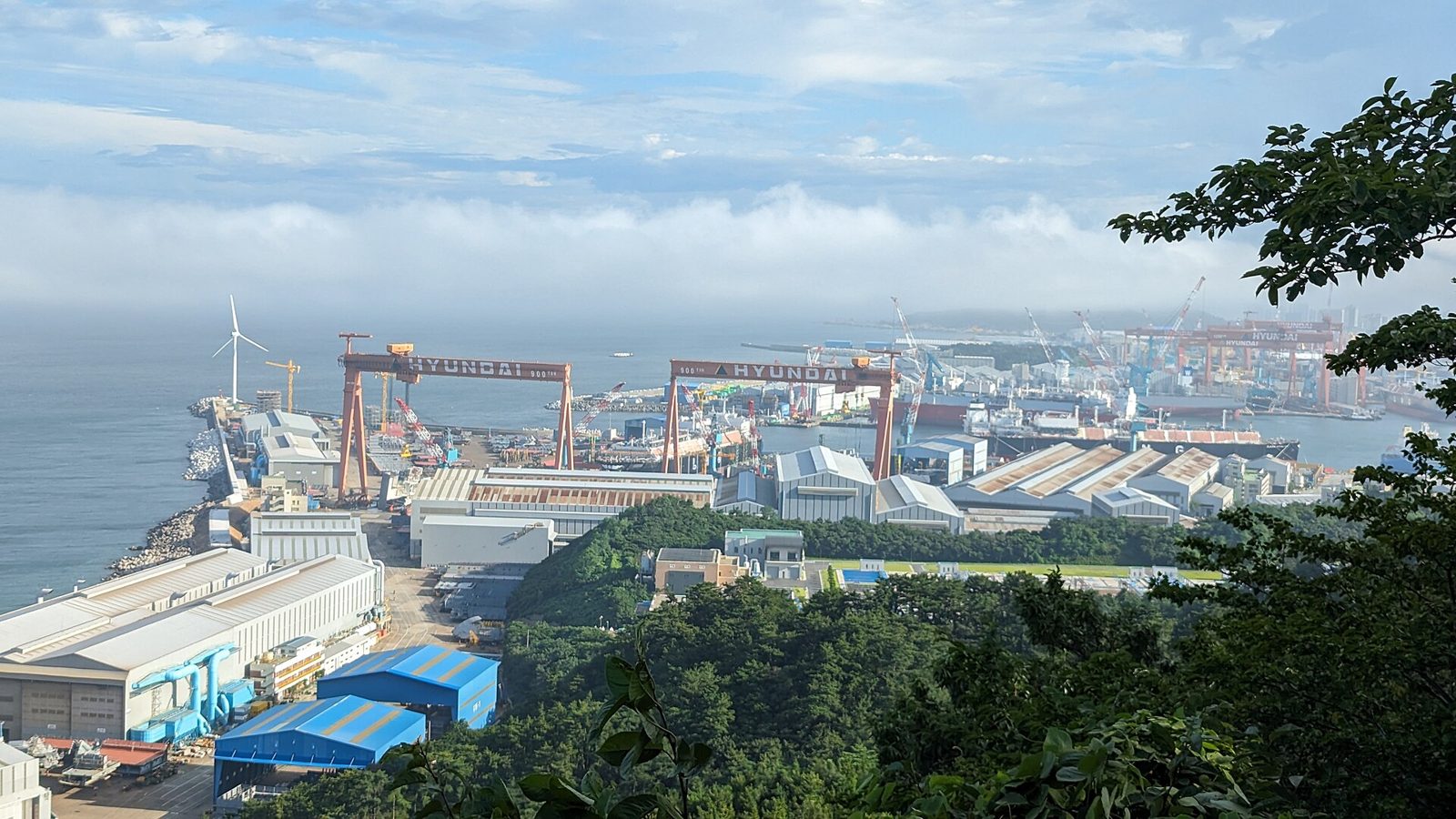
The shipbuilding and offshore industry designs and builds large vessels and offshore plants.
- $2.7B
Yearly corrosion cost of US shipping
- 25–30%
GHG rise from a 0.5 mm slime layer on the hull
- $763K
Average main-engine claim from lubrication failure
What is the shipbuilding and offshore industry?
Shipbuilding and offshore builds large structures used at sea for long periods, such as merchant ships, special vessels and offshore plants. A finished ship operates for decades under salt, moisture and wave loads, so corrosion resistance and structural strength must both be secured at the construction stage. Thick steel plate is cut, welded and assembled into blocks, then painted and fitted with equipment, so cutting and rust protection, welding aids, surface treatment and multi-layer painting, and shafting and drive lubrication all come into play.
Ships are built in blocks, and the longer a member waits outdoors, the more its surface condition changes. Rust or oil left before painting comes back years later as coating delamination and corrosion, and equipment is exposed to sea salt again during the delivery voyage. So when choosing chemicals, the time members spend outdoors, compatibility with later painting and inspection timing matter as much as performance. In shipbuilding and offshore, a chemical supplier also needs to read the order in which blocks are laid out to make proposals that can actually be used.
- 01
Steel cutting and processing
Thick steel plate is cut to drawings and joints machined. Tramp oil spoils cutting fluid early, and rusted cut faces unsettle weld quality. Choose cutting fluid by cutting performance, rust protection and tramp oil tolerance.
- 02
Sub-assembly and block assembly welding
Cut members are sub-assembled and welded into large blocks. Oxidized welds or stuck spatter add post-work such as grinding. Choose anti-spatter agent by adhesion prevention and residue on the weld.
- 03
Block shot blasting
Rust and mill scale are shot blasted off welded block surfaces to prepare for painting. Blasted steel has no protective film, so flash rust returns if painting waits. Choose pretreatment products by cleanliness and surface profile.
- 04
Block painting with primer, intermediate and top coats
Anticorrosion primer, intermediate coat and topcoat are applied in turn to prepared blocks to build a protective layer. Thickness variation or poor adhesion comes back as delamination and repainting in salt environments. Choose paint by anticorrosion performance, film thickness control and class approval.
- 05
Erection and hull antifouling paint finishing
Painted blocks are erected in the dock to complete the hull, and the shell below the waterline is finished with antifouling paint. Missed touch-up around erection welds causes local corrosion, and antifouling that enters water before full cure peels early. Choose finishing products by touch-up adhesion, coating compatibility and ingredient limits.
- 06
Propulsion shafting and rudder installation
Propulsion and steering systems such as propeller shafts, stern tubes and rudders are installed in the hull and the shaft is aligned. Rust on shafting surfaces leads to alignment error. Choose lubricants and rust preventive oils by long-term stability, seal material compatibility and owner specifications.
- 07
Piping and machinery outfitting
Equipment such as engines, pumps, valves and piping is installed on board. Chips or oil left inside piping lead to leak findings in hydrostatic tests. Choose cleaners and rust preventive oils by cleaning power and protection period.
- 08
Deck machinery and rigging outfitting
Deck machinery and rigging such as winches, cranes, chains and cables are installed and drives lubricated. When rain and sea salt wash off the film, drives corrode early. Choose lubricants by weather resistance, adhesion and reapplication interval.
- 09
Commissioning and machinery tests
Engines are started and hydraulic and cooling systems are checked in commissioning. Condensation left in gearboxes and pumps while moored starts corrosion. Choose oil types by the equipment maker's specification and internal rust protection during mooring.
- 10
Final inspection and acceptance
Paint, equipment and systems are finally checked and handed to the owner. Residue found before inspection means recleaning that delays delivery. Choose cleaners by cleaning power, coating safety and witness criteria.
- 11
Sea delivery and long-term preservation
Equipment shipped with the finished vessel is protected from corrosion until it reaches the customer's port. At sea, inside-outside temperature differences create condensation repeatedly, and wet corrosion means rework at the destination. Choose long-term rust preventives by protection period and performance in salt environments.
Regulation and certification
Classification society approval
The system in which classification societies such as KR, DNV, ABS and LR review and approve ship designs, materials and equipment. Coatings, sealants and lubricants are chosen from products with the society's type approval or listing.
MARPOL
The IMO convention controlling discharges of oil, noxious liquids, garbage and air pollutants from ships. Lubricant leaks, bilge handling and cleaner discharges must all be managed within its discharge rules.
US VGP and VIDA (EAL)
US rules on incidental discharges from vessels in US waters, with the VGP moving to new standards under VIDA. Oil-to-sea interfaces such as stern tubes are expected to use environmentally acceptable lubricants (EALs).
IMO PSPC
The IMO standard under SOLAS for protective coating performance in spaces such as seawater ballast tanks. Coatings must be pre-qualified systems, and surface preparation and film inspection are recorded against the standard.
FAQ
How do we stop rust returning when painting comes over a day after blasting?
Freshly blasted steel has no protective film at all, so flash rust starts with even slightly high humidity. The rate varies greatly by season and time of day, and in some cases differs within the same block depending on where it is stored outdoors.
Measuring how many hours it actually takes to reach painting decides the response. If painting can start within a few hours, adjusting the process sequence is better; if the gap is a day or more, a setup with a coat of primer that delays flash rust is used. Recording humidity and steel temperature together builds a basis for judgment.
Paint always peels in the same places within a few months. Is it the paint?
If it repeats in the same place, the surface preparation or painting conditions in that area are more likely than the paint. Joints, edges and tight corners are where blasting reaches less and film tends to go on thin.
Because edges and joints tend to get thin film, a common practice is to add an extra stripe coat there before painting large surfaces. Skipping it can leave those areas thin even when the overall average thickness meets the standard, so peeling repeats in the same places. On sites that record film thickness by area rather than as an average, this variation tends to show up before inspection.
Won't anti-spatter agents cause problems for later painting?
It varies by product, so it is best to check in advance. Oily components left around welds going into painting reduce adhesion and later show up as peeling at that spot.
In sections where painting follows right after, low-oil products are often chosen. Even with such products, however, components can bake on where welding heat has passed and not come off with ordinary cleaning. Where peeling has already appeared, reviewing spatter treatment and welding sequence together helps identify the cause.
Stern tube oil is leaking slowly. Will changing the oil type stop it?
Oil type sometimes helps, but seals and alignment are often the background. If the shaft is misaligned, a one-sided load falls on the seal and leaks repeat in the same place.
Checking whether leakage gathers in one direction or shows evenly around the circumference splits the path. If it gathers on one side, check alignment and seal condition first; if it is even, check viscosity, oil temperature and compatibility with seal materials first.
A leak was found in the hydrostatic test. Is it related to pipe cleaning?
Sometimes it is. Chips or oil left inside can get caught at sealing faces and register as a leak even when there is no real defect, and conversely, residue can plug a gap and leak later.
Handling after the test also matters. If test water remains in the piping, inner surfaces can rust again within days and go back for recleaning, and testing again in that state can repeat the same finding. For cleaners and rust preventive oils, whether they are safe on nonferrous metals and seal materials is a condition as well.
Can paint and shafting materials not be used at all without class approval?
It depends on the section. In spots under classification society witness inspection, such as painting, shafting and deck machinery, materials outside approved specifications are often hard to use there even if they perform well, and material names are recorded in inspection records.
Auxiliary chemicals not subject to witness inspection, such as cutting fluids and cleaners, are sometimes handled through in-house standards and safety documents. To enter inspected sections, though, specification listing comes first and it takes time, so many choose to build a supply history in non-inspected spots first.
Paint and thinner trigger emission inspections. What should we organize first?
Having both composition and usage data ready is the basis. Paint and thinner are subject to emission limits under the Clean Air Conservation Act, and new substances must be checked separately for registration.
If thinner use is growing faster than paint use, it is worth looking at painting conditions or spray settings. Sections where only thinner increases at the same volume can signal lower transfer efficiency, which raises both emissions and repainting work. On sites that keep safety data sheets and monthly usage by product in one place, these changes become visible earlier.
Why is there sometimes rust on equipment unpacked after the delivery voyage?
Condensation from temperature differences in transit is often the background. Even inside sealed packaging, water forms when day and night temperatures rise and fall, and as this repeats, rust preventive oil alone has difficulty covering the period.
If the packaging specification is set by the owner's requirements, that specification applies before any change in rust protection method. Room for adjustment within the specification is often in reducing surfaces touched by cushioning or adding desiccant, and if there is no room, it is realistic to plan rust re-protection work at the destination in advance.