From the melting furnace to rust-protective export packaging
Casting and forging melt or press metal into the core components of heavy industries such as automotive, shipbuilding, defense, wind and aerospace.
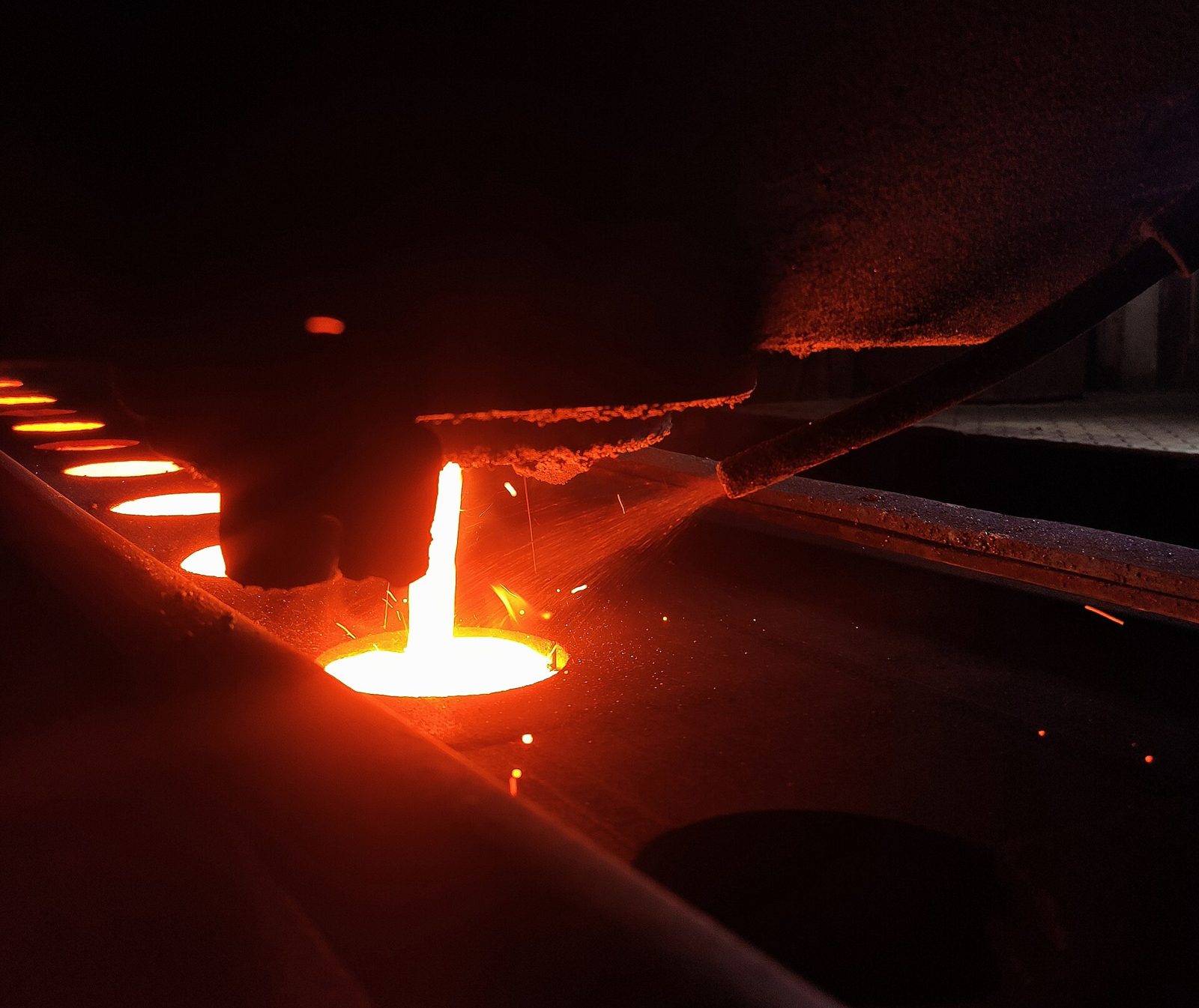
What is the casting and forging industry?
Casting and forging makes the parts that form the backbone of machines and equipment, either by melting metal into shape or by pressing heated stock into form. These parts go where they bear heavy loads and repeated stress, so internal structure and surface defects must both be controlled. Cast iron, cast steel and aluminum alloys are handled at high temperatures, so die release, high-temperature lubrication, anti-seize, shakeout and cleaning, quenching and rust protection are needed again at every point where temperature rises and falls.
The difficulty in casting and forging is that heating and cooling sections follow each other directly. Uneven lubrication on die surfaces leaves shapes unfilled or causes soldering, and unstable quenching conditions split hardness and residual stress even within the same part. So beyond chemical performance, fit with die specifications, behavior at high temperature, treatment routes for used oil and wastewater, and records of usage must all be handled. In casting and forging, the same chemistry gives different results depending on die and furnace conditions, so data sheets alone cannot settle a decision unless conditions are set together from the first application.
- €850M
Yearly cost of fixing gear distortion in Germany
- 01
Melting for casting
Metal scrap and raw materials are melted in furnaces into liquid metal. Dissolved hydrogen freezes as porosity during solidification. Choose ladle coatings and process chemicals by heat resistance and degassing effect.
- #Melt temperature
- #Uniform composition
- #Gas content control
- 02
Die preparation and release agent application for casting
Release agent is sprayed on mold and die casting die surfaces to ensure release and set die temperature. Mismatched die temperature and application amount cause gas defects. Choose release agent by release, dilution ratio and die temperature range.
- #Die release
- #Die temperature
- #Application rate control
- 03
Pouring and injection for casting and die casting
Molten metal is pushed into molds or die casting dies to fill the shape. Where the sleeve film breaks, plunger tips wear and fill defects increase. Choose plunger lubricant by film life at high temperature and residue buildup.
- #Fill speed
- #Plunger wear
- #Leak prevention
- 04
Ejection and anti-soldering for casting and die casting
Solidified parts are pushed out of the die and metal is kept from soldering onto the die. When ejector pin lubrication breaks, wear and seizure progress quickly. Choose anti-solder agents by heat resistance, ease of application and residue.
- #Ejector pin life
- #Soldering prevention
- #Assembly precision
- 05
Sand removal and surface cleaning of castings
Mold sand is shaken off after solidification, and oxide scale and sand residue on the surface removed. Leftover residue causes trouble again in heat treatment and machining. Choose cleaners and pickling chemicals by removal power and material reactivity.
- #Thorough cleaning
- #Surface roughness
- #Downstream compatibility
- 06
Billet heating and scale control for forging
Ingots are heated in high-temperature furnaces to a forgeable state. The longer they stay, the thicker the oxide layer and the more tool wear. Choose anti-scale coatings by oxidation suppression and ease of stripping.
- #Oxidation control
- #Energy efficiency
- 07
Forging and forming
Heated stock is pressed by presses, hammers and ring rolling into the target shape. Where the film breaks, stock sticks to the die and hot wear starts. Choose forging lubricant by release and residue.
- #Die life
- #Forging precision
- #Surface quality
- 08
Cooling and solidification
Forged parts are cooled in air or under controlled cooling to stabilize structure. Uneven cooling rates by area leave hardness variation and warping. Choose cooling fluids by cooling rate curves and oxidation stability.
- #Cooling curve
- #Uniform tempering
- #Environmental safety
- 09
Machining, finishing and trimming
Surface scale is removed from forged and cast parts, dimensions brought in and burrs and gates cut off. Unstable fluid management lets chips linger and roughens surfaces. Choose cutting fluid by lubrication and cooling balance and fluid life.
- #Tool life
- #Surface finish
- #Chip evacuation
- 10
Hardening and quenching heat treatment
Parts are reheated, quenched and tempered to final strength and hardness. If quench oil cannot follow thickness differences, hardness splits by area. Choose quench oil by cooling performance and thermal stability.
- #Microstructure control
- #Hardness distribution
- #Distortion control
- 11
Final inspection, rust protection and packing
Inspected parts are rust-protected and packed for transport and storage. On long routes, condensation brings up white rust and pitting. Choose rust preventive oil and VCI materials by protection period and application method.
- #Transit rust protection
- #Storage stability
- #Export compliance
Regulation and certification
ISO 9950
The test method for measuring the cooling characteristics of industrial quenching oils with a nickel-alloy probe. Quenching oils for heat-treating forgings are checked by their cooling curve and tracked for change in service.
IATF 16949
The quality management standard for the automotive supply chain. Plants casting and forging automotive parts need customer approval and change control even when switching release agents, quenchants or rust preventives.
ISO 9001
The international quality management standard that applies across industries. Process chemicals fall under its purchasing controls, so products are chosen from suppliers that can be evaluated and traced by lot.
Hazardous Materials Safety Act
The Korean law regulating the storage, handling and transport of hazardous materials such as flammable liquids. Keeping quenching oils or release agent concentrates that qualify as hazardous above the designated quantity requires permitted facilities and safety management.
FAQ
We keep getting soldering in die casting. Will a different release agent fix it?
Release agent sometimes helps, but die temperature is often involved. If the die is too hot, release agent evaporates before forming a film, so soldering can repeat in the same place even with more applied.
Changing release agents also means resetting dilution ratio, spray time and blow-off conditions. On the other hand, applying strong cooling to lower die temperature can increase misruns, so moving both conditions at once leaves no record of what worked. Recording where soldering concentrates and the die temperature at the time, by part number, gives values for the next adjustment.
More release agent aids release but adds porosity. Which should we prioritize?
As application increases, moisture and decomposition gas left on the die also increase, so there is a range where porosity and release move in opposite directions. Meeting both with application amount alone is often difficult.
Reducing application to control porosity often brings soldering back, and going back and forth between the two defects with one variable is the trap in this section. In some cases porosity dropped at the same application amount when drying time after spraying was extended slightly, and then adjusting spray equipment and blow-off conditions before the release agent gives better returns.
Forging die life is shorter than expected. Is it the lubricant?
Lubrication can be the cause, but die preheat and cooling conditions are often intertwined. When hot stock touches an under-preheated die, heat checking forms on the surface first, and wear can speed up along those marks.
Looking closely at marks on the die surface tells them apart. Web-like cracking first points to preheat and cooling conditions; scoring in one direction with stuck metal points to a broken lubricant film. Dies where both have progressed rarely recover life with a lubricant change alone.
Parts warp after quenching. Will changing quench oil help?
Some distortion comes from mismatched cooling characteristics, but loading method and flow conditions are often the source. When parts overlap or flow concentrates on one side, cooling rates can split even within the same part.
Slowing cooling to reduce distortion can drop hardness below standard, so matching both with one cooling rate is hard. Adjusting the loading fixture sometimes costs less than changing oil type, and if the warping direction changes from lot to lot, oil temperature, agitation and oil degradation are likely drifting first.
For parts going to defense or nuclear, do we need records even for lubricants?
For volume that requires material traceability, the chemicals used are sometimes included in traceability. For nuclear safety-class parts, materials are designated in quality assurance procedures, so changing a product often means revising the procedure.
In that case, the time needed to revise the procedure decides the adoption point more than product performance. If revision is tied to the regular audit cycle, the change may have to wait a year, so some sites start substitute reviews from the procedural schedule rather than a performance comparison. Collecting lot certificates and composition change history in advance saves time at the revision stage.
Exports show white rust on opening. Will a thicker coat of rust preventive oil do?
A thicker coat can delay it, but if condensation inside the container is the cause, the effect usually does not last. On routes with large day-night temperature swings, water can form and dry inside packaging repeatedly.
A thicker coat increases cleaning burden before assembly, and uneven thickness can trap moisture. When combining with VCI materials, check that the two products do not interfere with each other, and water marks left inside packaging are a signal pointing to sealing and drying before packing rather than coating thickness.