Customer storiesDefense precision-parts machinist (aluminum and stainless)
A defense parts machinist holding aluminum finish and stainless tool life with one coolant
- Customer
- Defense precision-parts machinist (aluminum and stainless)
- Industry
- Defense
- Product group
- Metalworking Fluids (MWF)
- Process · Material
- Precision machining (drilling and end milling, 3 consecutive 20-minute cycles) · 6000- and 7000-series aluminum, stainless steel
A machinist of precision defense parts that cuts 6000- and 7000-series aluminum and stainless steel in the same process met three conditions with one coolant: no aluminum staining, extreme-pressure lubrication for stainless, and long service on top-up alone. The customer and our team first established that all three depend on emulsion and pH stability, then moved to a long-life emulsion-type water-miscible fluid. Aluminum appearance stabilized, and tool consumption and fluid management cost fell together.
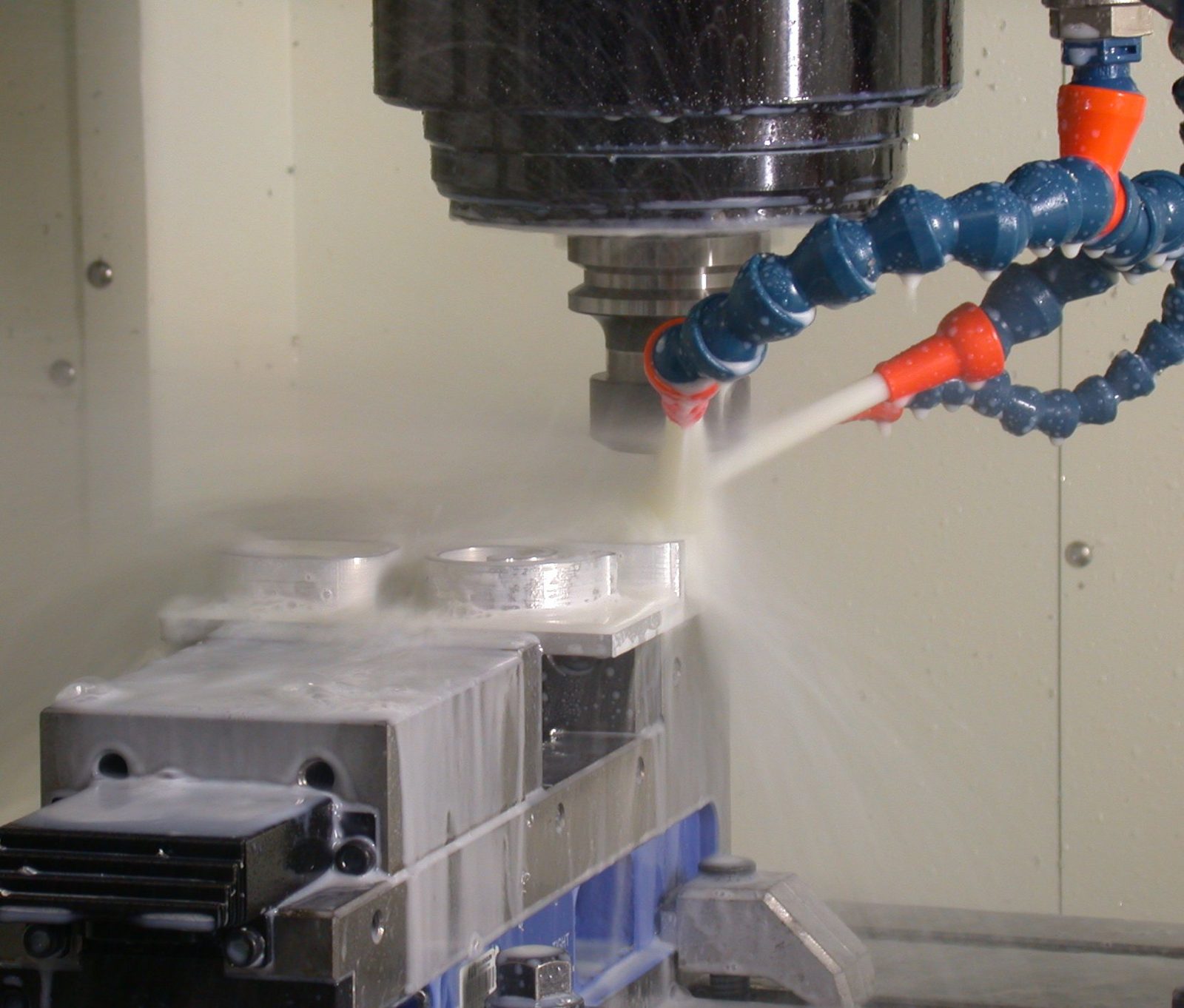
The customer is a precision machinist that holds a demanding defense-parts quality standard while cutting two very different materials with one coolant. It machines precision defense parts, housing covers among them, in 6000- and 7000-series aluminum and stainless steel. Its drilling and end-milling operations run as three consecutive 20-minute cycles. A part stays in the machine for close to an hour, so the coolant's lubrication and emulsion have to stay steady for that whole time.
The quality bar is high. Every aluminum part is inspected before delivery, and any color change on a machined surface is rejected as an appearance nonconformity. Machined parts go on to plating and other finishing steps, so whatever the coolant leaves on the surface is also part of what has to be controlled.
The customer set three targets, and all three had to be met at once. Machined aluminum had to stay unstained even after long exposure at room temperature, so parts would pass full inspection regardless of bath age. On stainless, extreme-pressure (EP) lubrication had to protect the heavily loaded cutting point steadily so inserts would not wear abnormally. Continuous machining makes frequent change-outs impractical, so the fluid also had to resist microbial growth and loss of bio-stability over long service on top-up.
The challenge: holding aluminum finish and stainless tool life from one sump
The previous water-miscible coolant met the standard when fresh, but its emulsion stability declined with service time, and the risk of aluminum staining grew with bath age. On stainless, the lubricating film wavered under high load, and whenever lubrication wavered, inserts wore abnormally, bringing scrapped material and unplanned stops. The sump was managed by considering a change-out when its condition worsened, and plating-sensitive components had to be checked separately. Staining, EP performance and bio-stability were each judged as a separate condition.
"Aluminum's fine with fresh coolant. A few months in, a part fails inspection now and then. So we said from the start, let's see what happens after it's been in the machine a long time."Production engineering lead, customer
The customer asked for one coolant that would hold the aluminum appearance standard and stainless tool life together. The problem was not how the fluid performed fresh but how it performed after long use. So before looking at products, the customer and our team set out to find when staining and insert wear increased.
The solution: tying three conditions to emulsion and pH stability
In the first one to two weeks, the customer and our team reviewed the 20-minute × 3 cycle, the material mix, how the sump was topped up and the emulsion condition by bath age. Right after a fresh fill, neither material gave trouble. As the bath aged, the point where the emulsion turned cloudy coincided with the point where aluminum inspection became harder to pass, and stainless insert changes became more frequent at about the same time. The two materials seemed to pose different problems, but both traced back to one property of the coolant: emulsion and pH stability.
On aluminum it is oxide chemistry. The natural oxide film on aluminum is stable from roughly pH 4 to 8.5 and slowly dissolves on the alkaline side. Water-miscible coolants run around pH 9 to protect ferrous parts and hold back microbes, so the fluid's aluminum stain inhibitors have to adsorb on the oxide first and shield it. As the bath ages these inhibitors are consumed, organic acids from microbial growth build up, and free fatty acids released as the emulsion breaks leave marks on the surface. Copper-bearing 7000-series alloys are more sensitive to these local reactions.
On stainless it is heat and friction. Austenitic stainless conducts heat at about a third of the rate of carbon steel, so cutting heat concentrates at the tool edge, the material work-hardens and cutting forces climb, and chips tend to weld to the edge as built-up edge. Under these conditions the EP components, which react with the metal surface at high temperature to form a protective film, must reach the cutting point steadily. Those components travel in the emulsion droplets, so when the emulsion breaks, less of them arrives and insert wear rises first.
If the emulsion lasts and the pH holds, the aluminum inhibitors and the EP package both stay active, and microbes find it hard to take hold. So the criterion became not "does it cut well when fresh" but "does it keep its initial condition after months on top-up alone". In weeks three and four we narrowed the candidates by working principle rather than by brand, along three axes. They were aluminum stain inhibition, meaning steel, aluminum and copper panels all stay unstained in a long room-temperature exposure test; chlorine-free EP lubrication that protects the heavily loaded cutting point on stainless; and emulsion and pH retention over long operation. Two further conditions were added: no silicone defoamer that could affect plating downstream, and low foaming under high-pressure coolant delivery.
The choice was a long-life emulsion-type water-miscible coolant designed for aerospace and defense precision machining. In the product's 48-hour room-temperature corrosion test, steel, aluminum and copper showed no discoloration, and the formulation reinforces both lubricity and EP performance. It is silicone-free with no plating-sensitive components, so plating downstream is unaffected, and dilution is around 5%. Only the coolant changed, but its design targets the cause found on site, the drift of emulsion and pH over time.
Adoption: from one parallel-run machine to a weekly measure-and-top-up rule
From week five to week ten, about six weeks, one machine ran on the new coolant in parallel. During that period the team logged aluminum inspection results on the same parts and insert condition and change points on stainless. Concentration and pH trends and foaming under high-pressure delivery were tracked as well.
In the third month all machines changed over, and the management rule changed with them. Judging the sump by look and smell, and considering a change-out when its condition worsened, gave way to measuring concentration and pH and then topping up. Concentration is read with a refractometer and pH with strips or a handheld meter once a week, and the sump is topped up with concentrate or premix when either drifts out of range. These measurements and the top-up rule became part of routine inspection.
The results: appearance, tooling and running cost moved by one coolant
From the sixth month on, aluminum appearance and tool condition were confirmed to hold through long top-up service. The emulsion no longer deteriorated sharply and its stability held, and aluminum parts rejected at appearance inspection for machined-surface staining fell from 3 to 5 a month to about 1. With lubrication holding at the heavily loaded cutting point, abnormal insert wear became less frequent and the insert change interval on stainless grew by about 20-30%. Staining, EP performance and bio-stability, once judged as three separate acceptance conditions, were all met by one fluid.
A longer-lived emulsion also held back microbial growth and odor. The full sump change-out that deteriorating fluid used to force every 3 to 4 months has not been needed once in the six months since, and coolant management cost, purchases and waste disposal combined, fell by about 30-40%. With no components that could affect plating, the link to downstream processes became more stable too. Defense clients check appearance and dimensions against the same criteria, lot after lot. With coolant condition now steady regardless of service time, the customer can explain its full-inspection results without reference to how old the sump is.
"We used to have days when a stainless insert would just go. Now the change point is pretty much the same every time, so planning tool stock is easier. And we worry a lot less about aluminum inspection."Machining foreman, customer
What's next: a log that plans top-ups and tool changes ahead
The customer and our team log insert change intervals and inspection results every month, to confirm that the roughly 20-30% longer change interval holds. They are also combining insert change points by material with the concentration and pH log in one sheet, so top-ups and tool changes can be planned ahead. The same log tracks how much longer the sump can run on top-up alone without a full change-out. They are also reviewing whether the same coolant can extend to lines that machine hard-to-machine alloys such as titanium.