Customer storiesDefense hydraulic equipment manufacturer and supplier
A defense hydraulics supplier that steadied new automatic lathes with a low-mist neat oil
- Customer
- Defense hydraulic equipment manufacturer and supplier
- Industry
- Defense
- Product group
- Metalworking Fluids (MWF)
- Process · Material
- Automatic lathe machining (continuous day and night operation) · Stainless steel, plain carbon steel
A defense hydraulic equipment maker adding automatic lathes to raise output moved to a neat cutting oil that meets stainless EP lubrication, low mist and odor, and consumption at once. The customer and our team established that higher speeds and continuous running unsettle lubrication and working conditions together, and chose a chlorine-free EP low-mist oil. Tool wear and dimensional scatter fell, mist and odor settled, and consumption came down too.
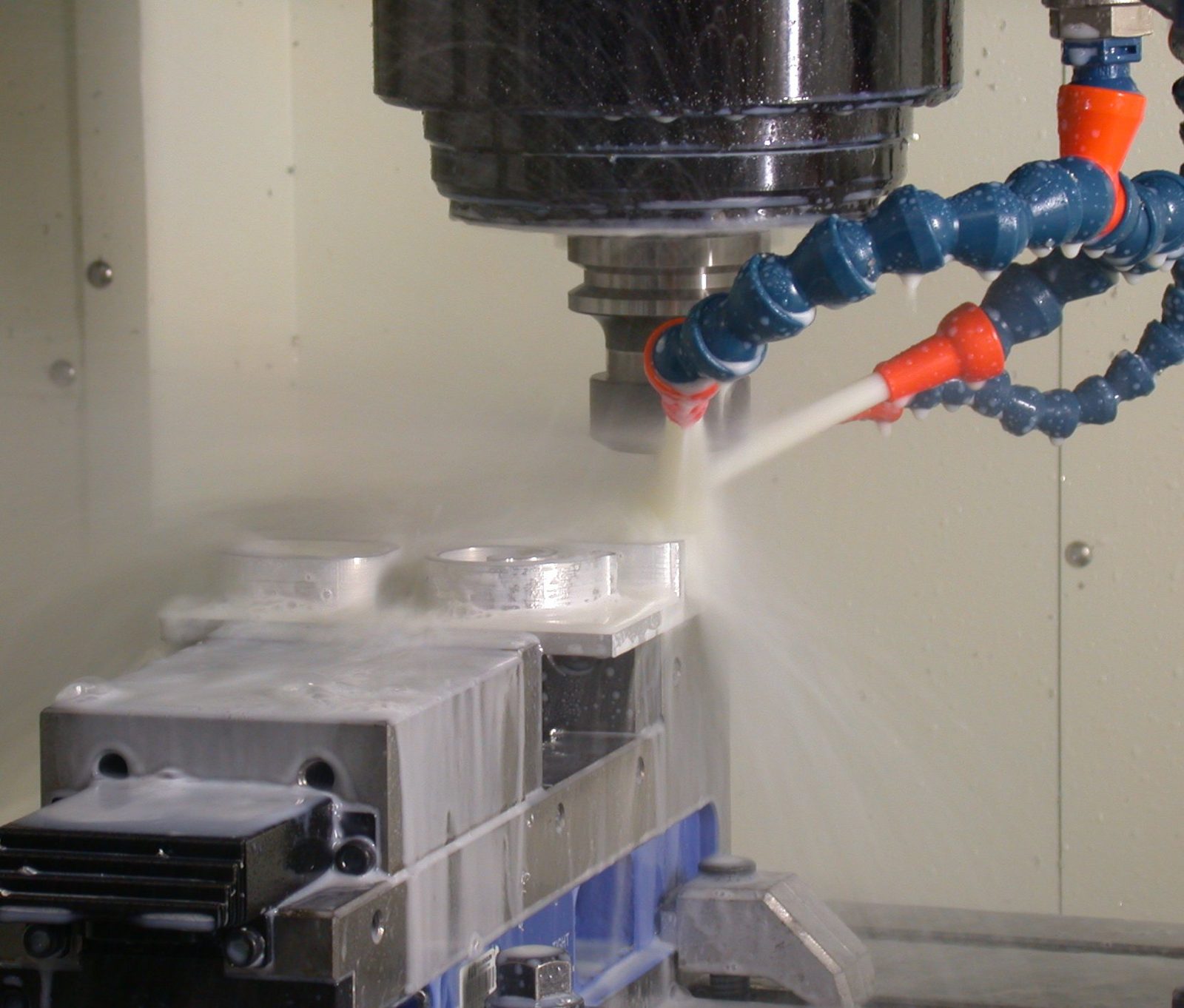
The customer manufactures and supplies hydraulic equipment for defense applications. To raise production efficiency it has recently brought in new automatic lathes and is increasing output, working mainly in stainless steel and plain carbon steel. The machines run continuously day and night, and machining accuracy and lubrication stability must hold at the same level throughout.
The company already had clear criteria for its cutting oil. Reclaimed oil, with its inconsistent performance, had been ruled out, and the search was for an alternative to a costly import that would place little burden on operators or machines. This is a company managing expansion and cost together while holding to defense quality standards.
The new automatic lathes raised cutting speed and continuous running time, and cutting conditions changed with them. The customer set four conditions. EP lubrication had to hold back insert wear in heavily loaded stainless cutting and reduce dimensional scatter, and low mist had to cut the oil spreading into the work area, improving visibility of the process and operator fatigue together. Low irritation meant no odor or skin irritation that becomes a burden over long shifts, and economy meant oil consumption kept in check so running cost does not rise.
The challenge: keeping stainless inserts and shop air in shape on faster lathes
The previous neat cutting oil had met the standard on the old machines, but at higher speeds and over longer continuous runs its EP performance did not hold up. With too little EP, inserts wore fast on stainless. Oil mist spread into the work area, and an irritating odor became a working-environment issue that hampered long shifts. The cut also became hard to see, an excess film raised consumption, and parts came off the machine with oil residue.
"Once the automatic lathes came in and we turned the speed up, the inserts just couldn't last on the old oil. But if we'd simply gone to a heavier oil, the mist and smell would've gotten worse, so we looked for something that handled both."Production manager, customer
In week 0, the customer asked for a neat oil that would meet stainless EP lubrication and working conditions together on the expanded automatic lathe line. Reclaimed oil was already excluded, and the goal was to replace a costly import. Before looking at candidates, the customer and our team agreed to first lay out everything that had changed together on the expanded line.
The solution: tying EP, mist, odor and consumption to cutting-point temperature
In weeks 1–2, the customer and our team reviewed cutting conditions by material, day and night running hours, where mist mostly formed and the daily top-up volume. Mist was heaviest around high-speed rotation and the cutting point. Oil carried off on chips and parts made up a large part of the top-up.
Stainless steel is a material that holds its heat. Its thermal conductivity is about a third of carbon steel's, so cutting heat collects at the tool edge, work hardening raises cutting force, and chips tend to weld to the edge. What protects the tool here is the EP package, whose components react with the metal surface at the hot cutting point to form a thin reaction film that stops metal-to-metal welding. Chlorinated EP additives once did much of this work, but concerns over machine corrosion, waste-oil disposal and operator exposure have moved the industry to chlorine-free designs combining sulfur and phosphorus components with esters. As speed rises, cutting-point temperature rises with it, so the EP film must hold at higher temperatures.
Mist forms by two routes. One is mechanical atomization: oil striking a fast-spinning workpiece and chuck breaks into small droplets. The other is thermal: oil evaporates at the hot cutting point and condenses in the air into fine droplets of about 1 micrometer, which stay airborne for a long time and are easily inhaled. A low-viscosity oil drains well from chips and parts, which lowers consumption, but it atomizes more readily, so it needs a low-volatility base oil and components that keep droplets from breaking up.
Odor comes from the same place. Active sulfur compounds that break down at high temperature, and degraded oil, are the main sources of irritating smell. EP, mist, odor and consumption were therefore tied to the same variables, cutting-point temperature and oil composition: weak EP raised cutting-point temperature, which raised mist and odor, and a thick film raised consumption. So the criterion became "does one oil meet all four conditions at once".
In weeks 3–4 we grouped the candidates by working principle: whether the EP package was chlorinated or chlorine-free, whether mist was reduced through base-oil choice or additives, whether viscosity and appearance suited visual monitoring, and whether the oil carried odor-forming components. No oil staining on parts after machining was added as a condition. The choice was a chlorine-free EP neat cutting oil built for difficult ferrous cutting, which holds a lubricating film at the cutting contact while its low-mist design lowers the mist and odor reaching the work area. It is clear and low in viscosity, so the cut is easy to watch, and it forms a thin, even film that does not cling excessively to parts and chips. It has a mild smell with minimal skin irritation, and according to the product data it leaves no oil staining after machining.
Adoption: from one parallel-run lathe to every new machine
In weeks 5–8, one automatic lathe ran the new oil in parallel with the previous one for about four weeks. The trial checked insert condition and dimensions on stainless and carbon steel separately, along with mist, odor and top-up volume. Insert change interval, dimensional scatter, daily top-up volume and operator feedback were logged on one sheet and compared with the previous oil.
The changeover came in month 3, when the oil went onto all new automatic lathes. The fluid on those machines moved from the previous neat cutting oil to a chlorine-free EP neat cutting oil. The existing lathe lines were left outside the scope of this changeover.
The results: one change in lubrication that moved tooling, air and cost
In month 6, the customer and our team reviewed tool life, consumption and operator feedback. Tooling showed the change first. Stainless inserts that had worn fast from insufficient EP now wear less, and the insert change interval is about 30–40% longer than on the previous oil. Dimensional scatter on stainless work has narrowed as well. Mist and irritating odor, which had spread into the work area, stayed stable through continuous day and night running, operator fatigue fell, and the clear oil makes the state of the cut easy to check by eye.
The excess film gave way to a thin, even one, and oil consumption came down, with daily top-up per automatic lathe falling from about 4–5 L to around 3 L, roughly 25–35% less. Lower consumption and longer tool life together improved the cost of running the process. Defense parts are checked against the same dimensional and surface criteria lot after lot. Being able to raise output after the expansion while dimensional scatter has narrowed means the quality record the company submits to its client stays at the level it held before the expansion.
"The night shift noticed first. Fewer people saying they had a headache after running all night, and since you can see inside the machine, we catch chip tangles right away."Automatic lathe foreman, customer
What's next: planning reorders from insert intervals and top-up records
The customer and our team keep logging insert change intervals and top-up volumes on the new automatic lathes, broken down by material. From those records we are building a rule together for planning reorders of tooling and oil in advance. They are also reviewing whether the same oil can extend to the existing lathe lines, starting with a parallel run on one existing lathe that compares the same items.