Customer storiesMachinist and supplier of aluminum aerospace fittings
An aerospace aluminum fittings machinist that folded rust protection into its wash tank
- Customer
- Machinist and supplier of aluminum aerospace fittings
- Industry
- Aerospace
- Product group
- Cleaning & Surface Prep, Corrosion Prevention
- Process · Material
- Water-based machining → clean-and-protect wash → poly-bag packing → shipment · Aluminum alloy aerospace fittings
A company that machines and supplies aluminum aerospace fittings removed the rust-preventive oil dip it had added to protect parts after shipment. The customer and our team put a water-based cleaner with built-in corrosion protection into the existing wash tank, so that removing machining soils and protecting the aluminum finish now happen in one flow. The process went from 5 steps to 4, and corrosion on delivered lots stayed reliably suppressed.
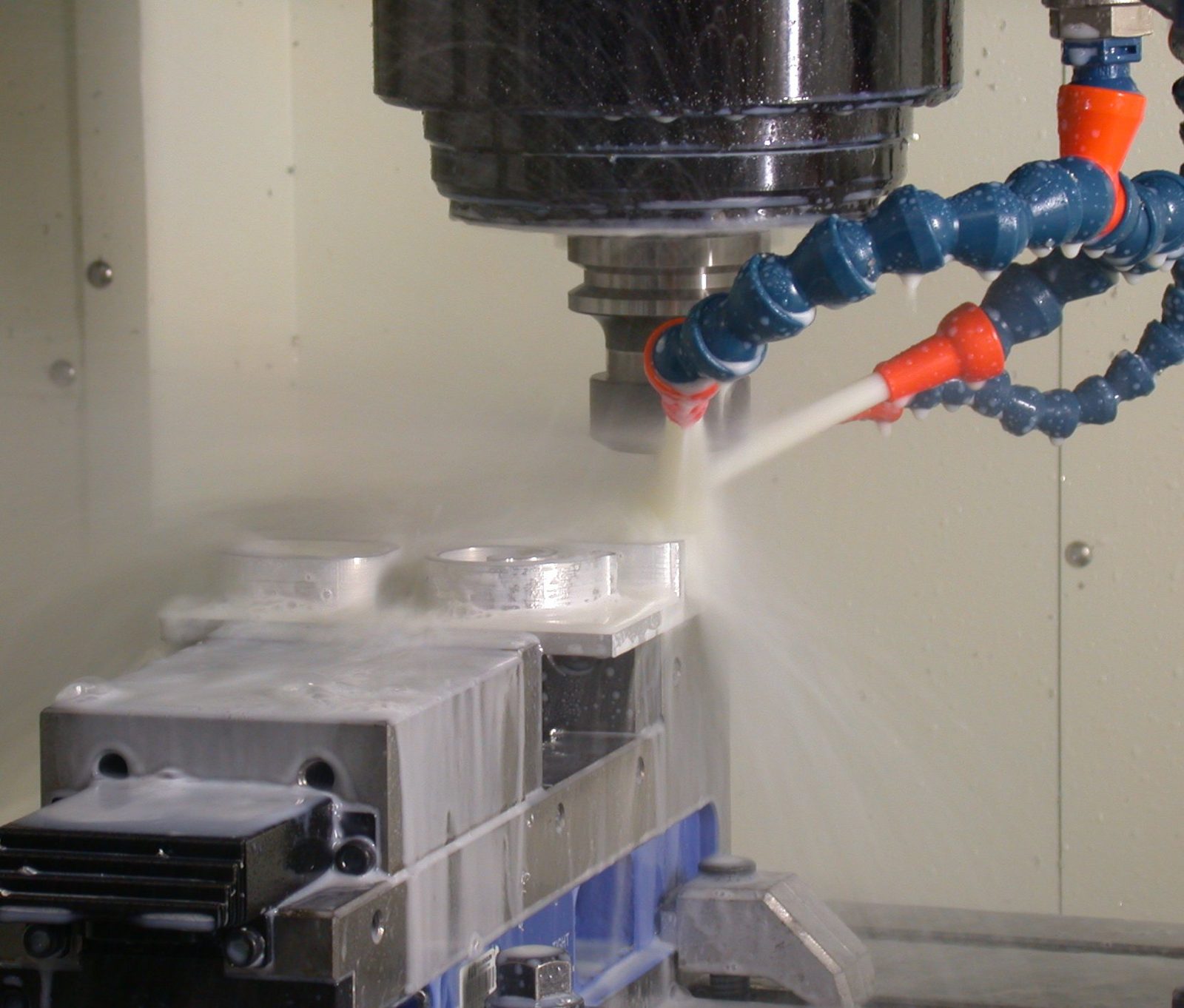
The customer machines and supplies aluminum alloy fittings for aerospace. Parts are cut with a water-based metalworking fluid, washed, packed in poly bags and shipped. In aerospace even a very small surface irregularity becomes a quality issue, so the level of protection a part gets right after machining ties directly to delivery confidence.
This company has answered surface-quality problems by going back to the process structure rather than living with them. When corrosion began appearing irregularly on aluminum surfaces after shipment, it first added a neat rust-preventive oil dip after the wash and stopped the corrosion. It then set out on a second improvement, to take that added step back out. This story records that second improvement.
The target was clear. The customer wanted to keep corrosion protection at its current level while cutting back the extra step and the control points the first fix had added. Cleaning and protection were to happen in one flow rather than as separate steps. Parts also had to leave with no oil or staining that would affect poly-bag packing or later assembly.
The challenge: keeping the rust protection without the extra dip
After the first fix the line ran in 5 steps: machining, washing, the oil dip, poly-bag packing and shipment. Dipping parts in neat rust-preventive oil solved the corrosion by displacing water and covering the surface with an oil film, but it left the shop with two new burdens. One more step meant more working time and more steps to run, and there were now 2 baths to manage, the wash tank and the dip bath. The oil in the dip bath needed its own change interval and contamination checks, and if that slipped, oil contamination or drifting concentration could create quality scatter and extra cost.
"The dip stopped the rust, but every time we changed the oil there was one more job to do. If we can protect it while we wash it, there's no reason to dip it again."Quality lead, customer
The customer asked us to help find a way to take back the step and the control points the first fix had added. Losing protection would defeat the purpose of a shorter process, so the bar was to remove a step with protection held where it was. Before choosing any product, the customer and our team set out to understand what the dip step was actually doing.
The solution: moving protection from after the wash into the wash tank
In the first one to two weeks, the customer and our team mapped the conditions on site. They reviewed the wash method and temperature, the dip-bath maintenance history, how dry parts were before packing, and where corrosion had appeared after shipment before the first fix. It showed up first at holes and edges, where water tends to linger while parts wait between washing and packing.
Clean aluminum is a reactive surface. Aluminum protects itself with a thin oxide film formed in air, but right after machining and washing that film is thin and uneven. If moisture and ions remain on the surface at that point, corrosion begins. High-strength aerospace alloys in particular contain fine copper-bearing intermetallic particles that behave as more noble sites than the surrounding matrix, so local corrosion starts readily around them.
A poly bag then traps the moisture. Moisture or coolant residue left inside cannot escape, and when the temperature drops in transit or storage, condensation forms on the inside of the bag. With chloride or similar ions present, white corrosion products appear as spots on the aluminum. Corrosion after shipment had shown up irregularly because the amount of moisture and residue left on each part differed.
What the dip step did, in other words, was cover the bare surface right after washing, and if the same could happen inside the wash tank, a whole step could go. So the criterion changed from "how well does it protect" to "can it protect in the same bath as the wash". In weeks three and four we sorted the options by working principle, not by brand: cleaning followed by separate protection, or a water-based clean-and-protect product that carries corrosion inhibitors and handles both in one bath. Among the latter, the short list came down to pH in a range safe for aluminum, compliance with aerospace cleaner specifications, a residual film free of oil and staining, and a fit with the customer's existing wash-tank method.
The choice was a water-based cleaner with built-in corrosion protection. While its surfactants lift the machining soils, corrosion inhibitors adsorb at once on the newly exposed metal and leave a thin protective film, so protection starts during the wash instead of after it. Strongly alkaline cleaners dissolve aluminum's oxide film, which is why the formulation had to clean and protect together at mildly alkaline pH. Parts leave the wash with no oily film or staining in place of the old rust-preventive oil film, so packing and assembly are unaffected. The product data gives protection for up to 6 months in indoor storage, and the product is VOC-free and non-flammable, which makes it easier to handle than neat oil.
Adoption: from a parallel trial on one wash line to a dip-free process
From week five to week ten, about six weeks, one wash line ran the clean-and-protect product in parallel. The dose was around 10%. Lots that skipped the dip were packed in poly bags alongside lots dipped in the standard way, and after a period of storage the surface condition of the two was compared.
In month 3 after the request, the line changed over and the oil-dip step was removed. Where dip-bath management used to be, only concentration and contamination checks on the one wash tank remain, and a wash-tank concentration rule was added to the work standard. The separate upkeep of change intervals and contamination for the rust-preventive oil dropped off the checklist.
The results: one bath, 4 steps and a protected aluminum finish
The process now runs in 4 steps: machining, clean-and-protect, poly-bag packing and shipment. Going from 5 steps to 4 removed the roughly 20 minutes each lot spent in the dip and draining, which shortened the process and raised production efficiency. The baths to manage went from 2, the wash tank and the dip bath, to 1 wash tank, and the neat-oil dip and the oil change-outs, about once a quarter, went with it. With only one bath to manage, there are also fewer places where quality scatter can creep in.
Before the first fix, corrosion had appeared irregularly on aluminum surfaces after shipment. From month 6 on, corrosion was confirmed as reliably suppressed on delivered lots without the dip, and delivery issues linked to it stopped. Aerospace clients look at process changes together with process-control records. A record showing a shorter process with protection maintained has added one more layer of confidence in the company as an aerospace supplier.
"Once the dip tank was gone from in front of the packing bench, even the way we walk around changed. No more wiping oily parts. They come out of the wash, we dry them and bag them."Packing foreman, customer
What's next: refining top-up and replacement rules for the wash tank
With control gathered into one wash tank, the customer and our team are refining the top-up and replacement rules for that tank. For now they are trialing a rule of checking tank concentration once a week and topping up when it falls below 8%. The replacement point will be set after a few more months of records on tank contamination and on surface condition after the wash. They are also reviewing whether lots with long storage times should add vapor-phase corrosion inhibitor (VCI) packaging.