Customer storiesMachine shop for aero-engine turbine blades
Fewer tool changes and consistent finish at an Inconel turbine-blade machining shop
- Customer
- Machine shop for aero-engine turbine blades
- Industry
- Aerospace
- Product group
- Metalworking Fluids (MWF)
- Process · Material
- Five-axis CNC machining (roughing, finishing) · Inconel (nickel-based superalloy)
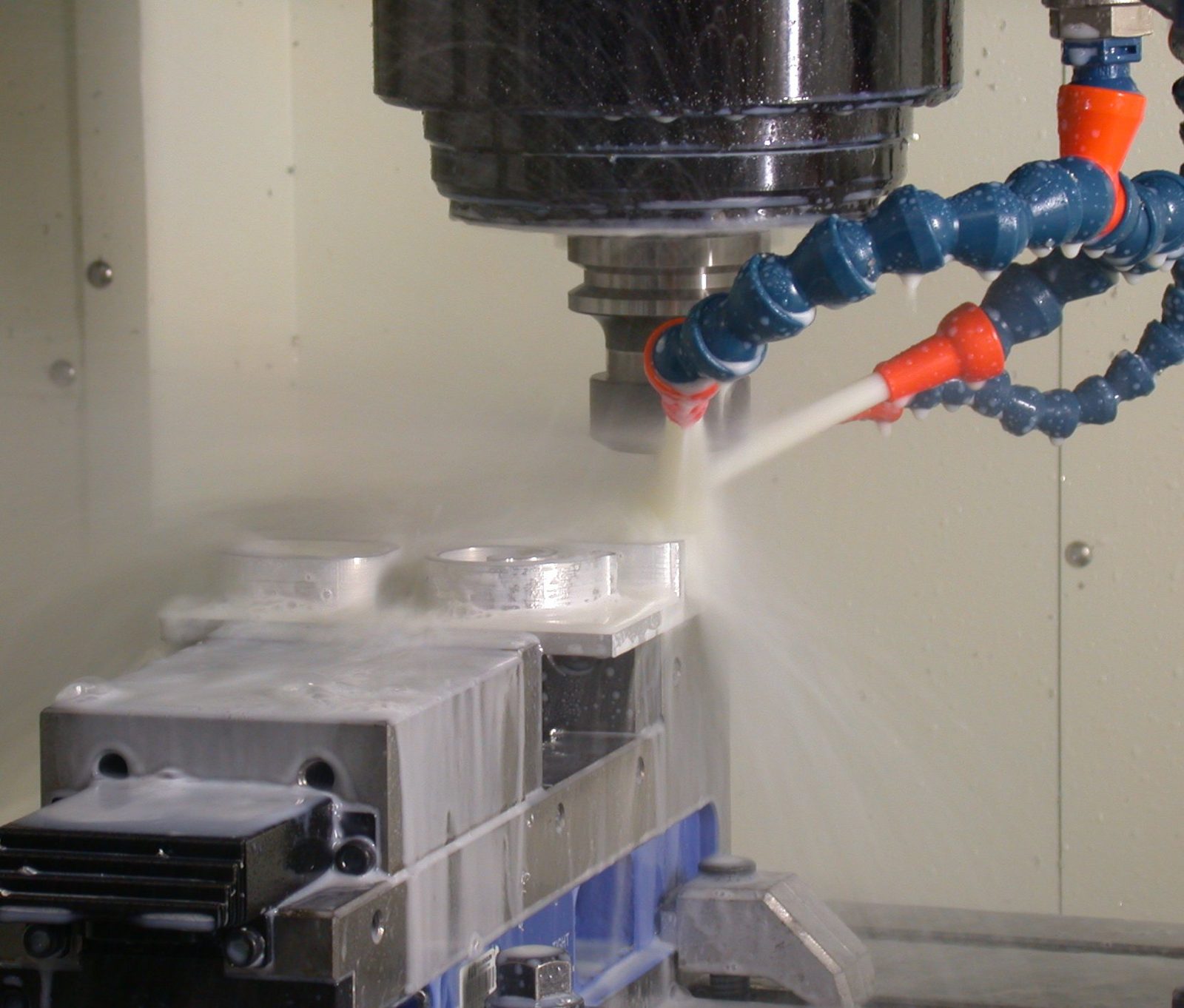
A shop that machines aero-engine turbine blades from Inconel on five-axis machines added a new requirement for its coolant: the same performance months after make-up, not just on day one. A long-life, biostable water-miscible coolant and a revised operating standard cut tool changes and stoppages, held surface finish steady and removed the odor from the shop.
The customer machines turbine blades for aircraft engines. A turbine blade sees the highest temperatures and pressures in the engine, so it is made from Inconel, chosen for heat and wear resistance, and its complex three-dimensional form is roughed and finished on five-axis machines. The shop works within an aerospace quality system that records dimensions and surface roughness part by part.
Inconel is a classic hard-to-machine alloy. Cutting resistance is high and heat concentrates at the cutting edge, so the slightest wobble in lubrication shows up at once as tool wear and poorer finish. In this shop, coolant is not a consumable but part of process capability.
The customer wanted a steadier flow of work through the blade line and set three conditions for the coolant. It had to hold tool life and surface roughness stable on Inconel and cut the number of times the line stopped for tool changes, to win back delivery margin. It had to resist degradation over long periods and deliver the same performance without frequent change-outs. And it had to leave the shop free of odor so operators could work long shifts in comfort.
The challenge: the same Inconel performance months after make-up
The shop had been running a general water-miscible emulsion. It was acceptable when freshly mixed, but its performance faded with time and it began to smell. Stoppages for tool changes were frequent, and surface roughness carried a variation that had to be managed. Change-outs were judged by smell and appearance, and concentration followed the previous operating standard. Against the new standard, what the old coolant lacked was not peak performance but long-term stability.
Its weaknesses grew with the age of the charge. Film strength varied with fluid condition, foam built up under the high-pressure delivery of the five-axis machines, and saponified residue accumulated inside the machines. The fluid had also been used mainly on ferrous work.
"We were treating fast tool wear and the smell as two different things. Once we put them side by side, the timing lined up exactly. From then on we saw the coolant as a process condition, not a consumable."Machining engineering lead, customer
The customer asked for a way to reduce line stops for tool changes and extend coolant life together. What it needed was a coolant that performed the same months later, not just in fresh fluid. So before looking at any product, the customer and our team set out to map the conditions on the shop floor.
The solution: choosing for lubrication margin months later, not fresh-fluid performance
In the first one to two weeks, the customer and our team checked through-spindle coolant pressure on the five-axis machines, the tool wear pattern, sump condition and change-out history. With the tool-change log laid beside the coolant change-out history, periods of frequent tool changes coincided with the coolant starting to smell, and roughness variation widened at the same time. Tool wear, finish and odor were not separate problems but results of one cause, a coolant that could not hold up over time.
Nickel-based superalloys such as Inconel conduct heat at roughly a quarter of the rate of carbon steel. Cutting heat cannot escape into the workpiece and collects at the edge, work hardening and hard carbide particles abrade the tool, and the hotter the edge, the faster adhesive wear sets in as tool and workpiece material bond. The coolant cools the edge, while its lubricity components and extreme-pressure additives form thin films at the hot, high-pressure contact that cut friction and adhesion. Under high-pressure through-spindle delivery on five-axis machines, a foamy stream does not reach the edge evenly.
The catch is that this margin depends on fluid condition. As microbes multiply they break down emulsifiers and lubricity components, the pH falls and the emulsion droplets coarsen, so the film becomes uneven. Calcium and magnesium from hard water saponify the fatty components, stripping out active ingredients and leaving sticky residue in the machine. On hard-to-machine alloys, then, tool life depends less on fresh-fluid cutting performance than on whether the same lubrication margin is still there months later.
In weeks three and four, the options were compared by working principle, not by brand, and narrowed on five criteria. They were extreme-pressure lubricity for Inconel, microbial resistance against long-term degradation, low foam under high-pressure delivery, a cleaning action that suppresses saponification and machine fouling, and a material range wide enough for aluminum and ferrous parts on the same machines in future. The first four each answer a cause found on the shop floor, and the last prepares for a wider mix of materials on the same machines.
The choice was a long-life, biostable water-miscible coolant (LUVISOL line) that combines an emulsion system with reinforced microbial resistance, synthetic lubricity components and extreme-pressure additives. The emulsion system slows microbial breakdown, which leaves the lubricity components and additives room to work at the edge months into service. It is formulated not to build foam under high-pressure machining and to suppress saponification, keeping machine internals clean. Aluminum shows no staining after 24 hours in a 5% dilution, and the fluid also covers hard ferrous alloys, so it meets the material-range criterion as well.
Adoption: from two months on one machine to the whole blade line
From week five to week 12, about two months, one five-axis machine ran the new coolant in parallel with the old one. The trial compared tool consumption per blade, roughness readings and the fluid's pH and concentration trend. Aluminum and ferrous test pieces were run as well to confirm the material range. Concentration was set for Inconel within the 5.0–12% range recommended for high-alloy steels.
From the third month the whole blade line changed over, and the operating standard changed with it. Change-outs are no longer triggered by smell, and refractometer concentration and pH are measured at set intervals and checked against limits, a check now written into the operating standard. Out-of-limit readings are corrected by top-up first, and a change-out comes after that. In the sixth month, tool consumption and stoppage records were compared, and the standard had settled in on the shop floor.
The results: tool changes on schedule and an even finish
The tools were the first place the difference showed. With the lubrication margin still in place months later, tool consumption per blade fell by about 20–25%, and stoppages for tool changes on each five-axis machine dropped from three or four per shift to around two. Surface roughness, which used to carry a variation that had to be managed, now spreads over about half its former range and holds consistent because the fluid no longer drifts. Suppressed saponification and fouling keep machine internals clean.
In the shop, the spoilage smell disappeared and operator satisfaction rose. The old fluid was dumped and replaced every two to three months, while the machine that has run the new fluid since the parallel trial has stayed within its concentration and pH limits for close to five months on top-ups alone. Coolant management moved from judging smell and appearance to regular concentration and pH checks. In a process where a single part carries a high value, holding roughness and tool life steady also means the machining records sent to the engine maker read the same from batch to batch.
"We used to call tool changes by feel. Now they mostly happen when we planned them. And the smell being gone, that goes without saying."Five-axis machining foreman, customer
What's next: linking the concentration window to tool life
The customer and our team are now pooling tool consumption per blade with the coolant concentration and pH log. With those records they are checking how much further tool life extends when concentration, now run within the 5.0–12% range, is held to a tighter band. The fluid life on the machine that has run the new coolant since the parallel trial is still being logged, and the period it holds its limits on top-ups alone will become the change-out interval in the operating standard. Extending the coolant and the same checks to other lines that handle aluminum and ferrous parts on the same machines is also under review.