Customer storiesPrecision mold maker for home-appliance and automotive-parts customers
A precision mold maker that kept micron accuracy through a switch to neat cutting oil
- Customer
- Precision mold maker for home-appliance and automotive-parts customers
- Industry
- Machinery & Precision Machining, Automotive Parts
- Product group
- Metalworking Fluids (MWF)
- Process · Material
- Precision mold machining on machining centers (water-miscible to neat oil conversion) · Mold steels
A precision mold maker supplying a major home-appliance company and Japanese automotive-parts makers fully converted a water-miscible process it had run for 10 years and more to neat oil, because its new plant site restricts water-miscible coolant. The customer and our team settled accuracy, operator safety and visibility of the cut together at the design stage and chose a chlorine-free, low-mist neat oil. Production ran steadily after the move.
The customer supplies precision molds to a major home-appliance manufacturer and to Japanese automotive-parts makers. Micron-level machining accuracy is its delivery standard, and its overseas customers check surface finish and dimensions against strict inspection criteria. Over 10 years and more of running a water-miscible coolant process, it has built a skilled system for machining-center and precision mold work.
While it was preparing a plant move to add capacity, the new site was designated an environmental control zone where the use of water-miscible coolant is strictly restricted. This was not a product swap but a redesign of the whole body of water-miscible know-how into a neat-oil process. The customer treated the conversion as a chance to align quality, safety and compliance at once.
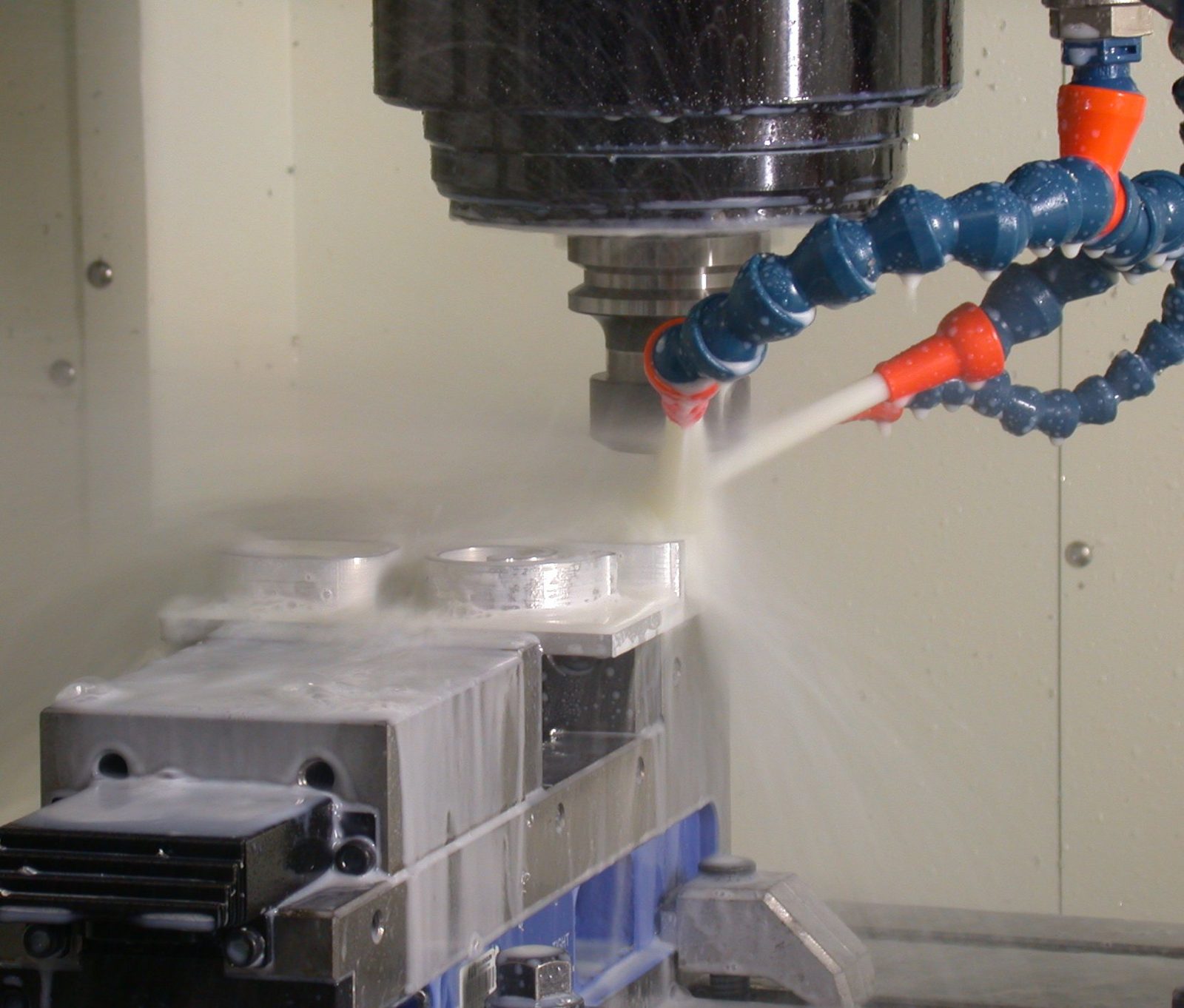
The customer set three standards. Finish and dimensions were not to scatter during the conversion, and the inspection criteria of overseas customers, Japanese buyers included, had to be passed as before. The concerns of shop-floor staff with almost no neat-oil experience had to be eased: respiratory risk from oil mist, the possibility of fire, odor and skin irritation. And the real-time visual check of the cut that the team was used to with water-miscible fluid was to be kept as far as possible.
The challenge: moving a micron-accuracy mold shop off water-miscible coolant
The line had run on water-miscible coolant. Water's high specific heat carried the cutting heat away, and the clear fluid let operators watch the cut in real time. Mist was of little concern, and EP lubrication sat at the level a water-miscible fluid provides. Rust protection, though, was a separate step to manage, and the process generated water-miscible waste fluid. With that coolant restricted at the new site, the whole system had to move to neat oil.
Water-miscible coolant is highly transparent and makes the cut easy to watch, whereas neat oils are often less transparent and harder to respond to on the floor. Overseas customers would inspect the same finish and dimensions after the move, so none of accuracy, safety or visibility could be given up. The task was to secure EP lubrication, operator safety and visibility together, with compliance as the premise.
"We'd done 10 years on water-miscible only, so everyone thought oil meant fires and headaches. So before talking about any product, we said, let's check those worries one by one."Production manager, customer
The customer asked for a review of a conversion to neat oil that would meet the new site's restriction on water-miscible coolant. What it needed was not just an oil that passed the rule but a conversion design that would carry over the accuracy and familiarity built on water-miscible fluid. So the design work started from site conditions, not from the move date.
The solution: turning operator concerns into selection criteria
From week one to week three, the customer and our team documented cutting conditions by machine, the accuracy standard and the rust-protection step in the water-miscible process. Alongside them they wrote down what shop-floor staff worried about in moving to neat oil. The staff wondered whether mist would make breathing uncomfortable, whether there could be fires, whether skin would suffer from contact, and whether they would still see inside the machine. That list became the selection criteria.
Moving from water to oil first changes how heat leaves. Water has about twice the specific heat of mineral oil and more than four times its thermal conductivity. Water-miscible coolant carries a lot of heat away quickly but lubricates weakly; neat oil carries less heat but lubricates strongly, reducing friction heat and built-up edge at the source. In micron-level mold work that difference can show up as thermal displacement of the workpiece and spindle, so oil temperature must be held constant and flow kept steady. Surface finish usually favors the better-lubricated side.
Air and water change too. At high spindle speeds and a hot cutting point, oil becomes mist through atomization and through evaporation and condensation; fine mist is easily inhaled, and if it collects in an enclosed machining space, hot chips or sparks from a tool break can start a fire. A formulation that makes little mist, a low-volatility base oil, mist collection and fire suppression in the machine enclosure together form the countermeasure. Machines converted from water-miscible fluid easily keep residual fluid in pipework and tank corners, condensation can bring water in too, and oil with water in it forms rust and sludge and loses lubricity. The oil's ability to reject water quickly and let it settle out therefore matters, and since the oil itself leaves a thin film on the metal, the short-term rust protection that was a separate step can be taken over by the cutting oil.
The question therefore became not "does it pass the regulation" but "does neat oil keep the accuracy and familiarity built over 10 years on water-miscible fluid". From week four to week six we grouped the candidates by working principle, not by brand. The shortlist was narrowed on chlorinated or chlorine-free EP, how mist was reduced, the raw materials behind odor and skin irritation, clarity, water separation and short-term rust protection. The conversion procedure itself became a condition: cut parts in advance on one machine at the old plant before the move, and decide how residual water-miscible fluid would be flushed out of the machines.
The choice was a chlorine-free neat cutting oil that forms a stable chlorine-free EP lubricating film even under extreme pressure while producing far less mist than conventional neat oils. Its raw materials are chosen for low odor and low irritation, and it is clear, so the visual check of the cut familiar from the water-miscible process can largely be kept. Its water-separation performance handles residual water and condensation in the machines, and its short-term rust protection absorbs the separate rust-protection step into cutting-oil operation. It cannot carry heat away as water does, but because lubrication cuts the heat generated in the first place, the remaining heat was left to oil temperature control.
Adoption: from test cuts on one old-plant machine to the plant move
From week seven to week 12, before the move, one machine at the old plant was converted to neat oil for test cuts. It machined the same mold components and compared finish, dimensions, mist, oil temperature drift and operator impressions with records from water-miscible days. The trial was also a rehearsal, on a single machine, of the conversion the move would require.
The plant moved in month four. Residual water-miscible fluid was flushed from each machine before it was charged with oil, and mist collection and enclosure fire suppression were checked at the same time. Oil temperature is held steady with a chiller. The rust-protection step of the water-miscible process dropped out of the work sequence and moved into cutting-oil operation.
The results: a compliant neat-oil process proven with the same inspection records
From month seven, production after the move ran steadily, and the customer and our team reviewed compliance, machining quality and working conditions together. A neat-oil process that meets the new site's environmental rules is in place, and the 6–8 tonnes or so of water-miscible waste fluid it generated each year is gone. By passing overseas customers' inspection criteria in the same way as before the move, the customer can show its clients, with the same records, that a conversion driven by regulation did not lower its quality standard.
Machining quality was also confirmed in before-and-after measurements. Finish on finishing passes went from around Ra 0.4μm with water-miscible coolant to around Ra 0.3μm after the conversion, as stronger lubrication cut built-up edge and left a finer surface. Key dimensional scatter stayed within the same ±5μm as before the move, because the chiller held oil temperature steady and kept thermal displacement in check.
Lower mist eased safety concerns and kept the cut visible, lightening the adjustment for staff new to neat-oil processes. With the rust-protection step managed separately in the water-miscible process now inside cutting-oil operation, the rust-protection work of around 30 minutes per lot of mold components dropped out and the process became simpler. A water-miscible system run for 10 years and more was fully converted to neat oil, and the customer completed that conversion in a way that aligned quality, safety and compliance together.
"The first few weeks we were tense every time we opened the machine door, but you can see inside better than we expected and there's hardly any smell. Now people say the surface comes out finer than before."Machining-center operator, customer
What's next: setting change-out by water content and oxidation in the oil
The customer and our team are now analyzing water content and oxidation in the oil once a month and building a rule for setting change-out and top-up points from those readings. Water that has separated to the bottom of the sump is drained before water content passes 0.1%, and when oxidation advances, partial replacement and top-up come before a full change-out. Filtration suited to finishing operations that generate many fine chips is also under review. Finish and dimensions are re-measured every quarter on the same mold components, to confirm that around Ra 0.3μm and ±5μm scatter hold as the oil ages.